
The Post-AI Workforce: What Actually Happens to Corporate Headcount After Successful Deployment
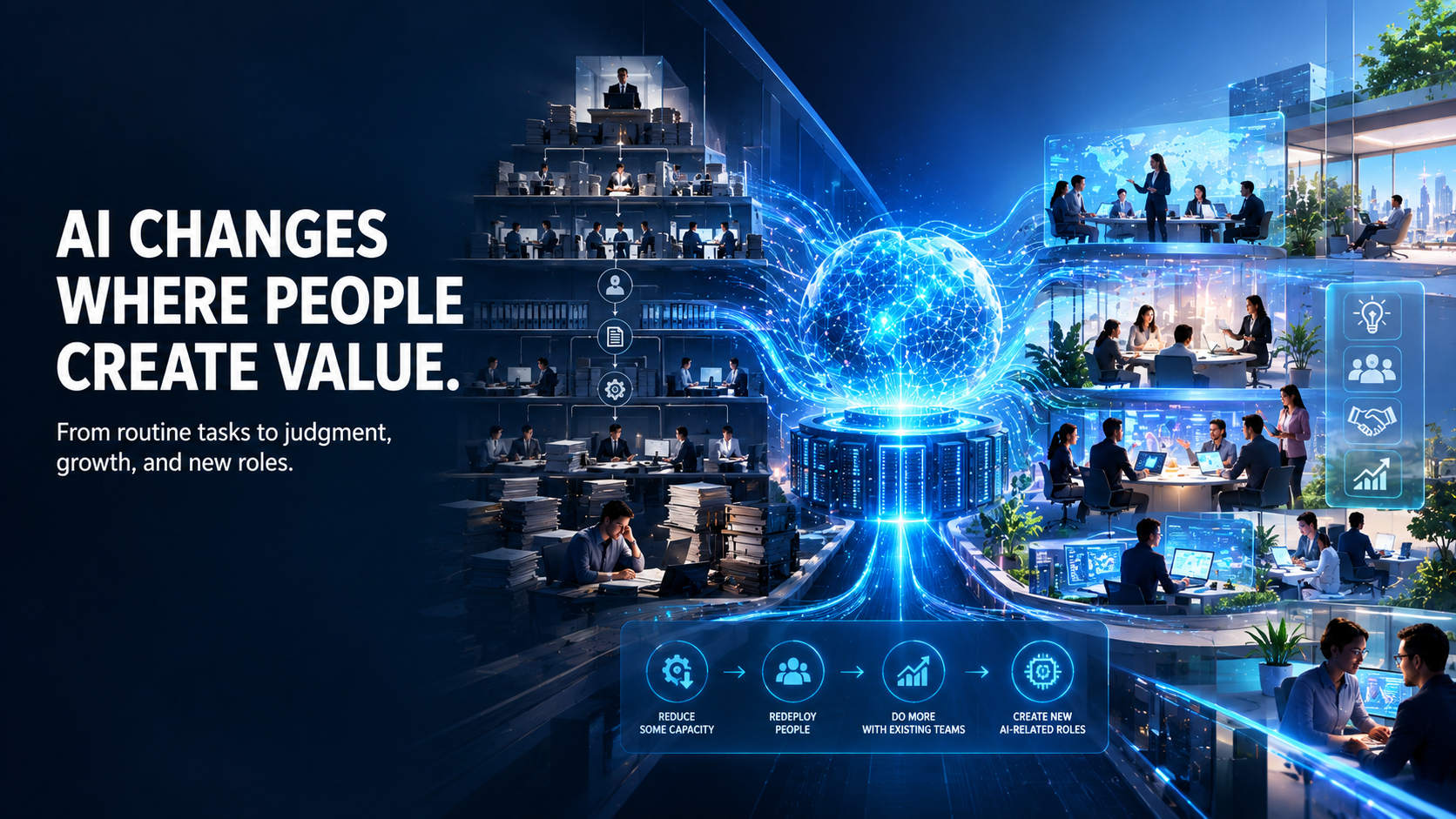
When enterprise artificial intelligence initiatives are launched in isolated, sandboxed environments, early metrics often generate a false expectation among executive leadership: that automating a specific task will directly translate into a 1:1 reduction in human workforce numbers. In controlled pilot programs, automated task completion is easily measured—a natural language processing model parses contract clauses in seconds, or a predictive maintenance algorithm diagnoses machinery friction faster than a master technician. However, translating these localized task automations into full-scale enterprise operations exposes a fundamental misunderstanding of organizational economics. Demonstrating time savings in an isolated trial is structurally distinct from scaling an operational deployment across a complex enterprise. When AI moves from pilot to scale, the assumed direct line between localized task automation and linear headcount reduction breaks down entirely.
At its economic root, artificial intelligence is a prediction machine. Modern economic research demonstrates that AI dramatically reduces the cost of prediction. In economic terms, when the cost of a foundational input drops precipitously, the value of its complementary inputs increases. The primary complementary input to AI prediction is human judgment—the capacity to evaluate context, handle exceptions, execute ethical reasoning, and make complex decisions under ambiguity. Consequently, a successful enterprise AI deployment rarely results in a simple, linear reduction of human headcount. AI restructures the fundamental composition of enterprise work, operational economics, and organizational velocity. Rather than destroying occupations, AI shifts human labor away from rigid, rule-governed task execution toward predictive decision-making and exception handling. The primary organizational catalyst of AI operationalization is a fundamental transformation of workforce composition and asset productivity, altering how enterprise capacity is structured rather than merely shrinking the payroll.
The Linear Redundancy Fallacy in Enterprise AI Initiatives
Macroeconomic predictions regarding automation frequently overestimate job elimination because they confuse the automation of individual tasks with the complete destruction of occupations. Sweeping macroeconomic projections often miss how work is structurally organized. A job is a complex bundle of heterogeneous tasks requiring varying degrees of sensory perception, contextual reasoning, emotional intelligence, and non-routine problem solving. Automating several routine computational components within an occupation fundamentally alters the daily workflow of the employee, but it rarely destroys the occupation itself.
The reason macroeconomic models project such vast automation vulnerability is that corporate management has historically designed roles to be intentionally narrow and low-scope. Bureaucratic management paradigms have historically treated workers as costly human machine substitutes slotted into rigid, highly circumscribed operational procedures. This design legacy creates a dangerous cognitive trap for executives: mistaking low-scope, rule-bound role design for a sign of low human worker capacity. When management restricts human agency to repetitive procedural execution, the lack of creative output is an architectural artifact of the organization, not a limit of the human mind.
As we analyze the division of labor between human intuition and algorithmic prediction, it becomes clear that when an employee’s daily work is governed entirely by rigid operational rules, the employee is frequently unaware of the value of gathering information and making decisions. Legacy bureaucracy relies on rules because human information processing and real-time prediction were historically too expensive. Rules were used as crude substitutes for real-time judgment. AI prediction engines invert this economic constraint. By lowering the cost of prediction, AI eliminates the necessity for rigid, rule-bound procedural workflows. When an AI handles predictive estimates (e.g., forecasting credit risk, diagnosing equipment failure, or triaging customer intent), it removes the procedural rule that previously constrained the human worker.
This structural shift exposes previously latent information-gathering and decision-making capacity across the front line. Unencumbered by routine compliance tasks, frontline employees are forced to evaluate context, manage edge-case exceptions, and exercise human judgment. The operational bottleneck shifts instantly from rule execution to exception resolution, requiring organizations to redesign roles around human empathy, negotiation, and contextual reasoning.
The Five Real-World Headcount Scenarios After Scaling AI
When enterprise AI deployments reach operational scale, headcount does not respond uniformly. Executive leadership faces five distinct post-deployment workforce outcomes, determined by business growth potential, process flexibility, and underlying enterprise architecture.
The first outcome is direct layoffs and reductions. This occurs under narrow, restrictive operational conditions: specifically where total addressable market volume is strictly capped, business processes are fully standardized and zero-judgment, and leadership views the functional domain purely as a cost center to be minimized. In high-volume, highly transactional back-office environments (e.g., legacy invoice processing or standardized transaction reconciliation), AI automation directly absorbs task volume. If business volume cannot expand and frontline employees are granted zero authority to exercise judgment or offer higher-value services, unlocked capacity translates directly into headcount elimination. For instance, a corporate accounts-payable unit processing a fixed, capped volume of annual invoices deploys an AI document-processing engine that increases processing velocity by 80%. Because the corporate parent operates in a non-growth utility market and treats back-office operations purely as administrative overhead, management cuts transactional clerk slots to reduce the baseline payroll bill.
The second outcome involves hiring freezes and natural attrition absorption. Rather than executing abrupt, morale-damaging mass layoffs, sophisticated enterprises absorb major AI-driven productivity gains by maintaining static output while leveraging non-replacement of voluntary turnover. In corporate functions characterized by high baseline attrition (typically 15% to 20% annually), management utilizes AI tools to continuously absorb the workload of departing personnel. Total headcount shrinks naturally over a 24-to-36-month horizon without incurring severance expenses, triggering union friction, or damaging organizational morale. A clear example of this is an enterprise customer support center with hundreds of agents experiencing high annual turnover. By deploying conversational AI engines that automatically resolve routine tier-1 inquiries and assist agents on complex cases, the enterprise can retain remaining headcount, allow natural attrition to downsize the unit, and handle higher total inquiry volume at zero incremental labor cost.
The third outcome is strategic redeployment and internal mobility. Pioneering enterprises leverage capacity unlocked by AI to transfer human talent into under-resourced, strategic, or revenue-generating business units. Freed from manual rule execution, human workers are systematically cross-trained and transferred into market-facing, relationship-oriented, or complex operational roles. This approach treats domain expertise and institutional knowledge as valuable capital assets rather than disposable labor costs. Industrial powerhouses demonstrate how cross-training eliminates structural layoffs. Backed by an explicit no-layoff policy, frontline teams welcome process automation and predictive tools because unlocked capacity leads to internal mobility rather than unemployment. For example, a retail banking group deploys predictive AI models that handle routine mortgage document verification, reducing processing time per application by 75%. Instead of terminating back-office underwriters, the bank cross-trains them into specialized commercial relationship managers and proactive wealth-advisory roles, capturing an underserved mid-market client segment and driving a massive expansion in new loan originations.
The fourth outcome is capacity expansion, where the enterprise achieves higher output with equal headcount. In growth-oriented markets, AI augmentation allows existing operating teams to scale transaction throughput and asset productivity exponentially without requiring linear headcount growth. Predictive AI removes cognitive friction and operational bottlenecks, allowing human teams to sweat the assets. Capital efficiency skyrockets as static headcount manages radically higher operational volume per capita. A global corporate legal department servicing a rapidly expanding software firm deploys AI contract-analytics engines. Rather than increasing its legal operations team from 50 to 150 specialists to manage a massive spike in commercial vendor contracts, the enterprise keeps team headcount static. The augmented team reviews, negotiates, and executes three times the contract volume while improving turnaround times dramatically.
The fifth outcome is the creation of unprecedented roles and micro-capabilities. Scaling AI enterprise-wide requires novel oversight, auditing, and maintenance infrastructure, while simultaneously creating platform dynamics that allow internal entrepreneurs to launch net-new micro-businesses. Headcount shifts toward auditing algorithmic bias, managing data pipelines, training edge-case models, and executing frontline entrepreneurial ventures funded by platform infrastructure. For example, a global healthcare provider deploying diagnostic AI models across its imaging network creates dedicated technical roles for AI Model Auditors, Clinical Data Curation Specialists, and Algorithmic Ethics Compliance Officers. Concurrently, frontline radiographers leverage the diagnostic platform to launch an internal micro-venture offering specialized, real-time remote teleradiology consulting to rural clinics, creating an entirely new revenue stream for the health system.
Swallowed Dividends: How Bureausclerosis Dilutes Technological Productivity
The primary reason enterprise AI efficiency gains fail to show up as line-item payroll savings on corporate income statements is that middle-management bureaucracy swallows the excess capacity. Studies reveal that the bureaucratic class comprises a massive portion of the national workforce and consumes a staggering percentage of total compensation. Research highlights that nonmanagerial employees spend up to 16% of their working time complying with internal rules and administrative regulations. Data from Bureaucratic Mass Index surveys demonstrate that corporate workers spend an average of 27% of their time on low-value bureaucratic chores—preparing internal reports, securing multi-layered sign-offs, and attending review meetings.
This internal focus trap dilutes potential technology dividends. When AI automates a frontline task, the time saved by frontline workers is instantly consumed by the organizational friction ratio—requiring employees to complete additional internal compliance tracking, write status reports, or navigate administrative sign-offs. Large enterprises operate with a high number of management layers compared to smaller, nimbler firms. Executives in these large structures spend nearly half of their working time on internal matters—resolving internal disputes, wrangling budget resources, managing corporate politics, and negotiating targets—rather than engaging the market. This structural friction creates a hostility to bottom-up innovation, making it difficult or nearly impossible to launch grassroots projects.
Traditional command-and-control management structures stall AI operationalization by enforcing rigid supervisory checks on AI-assisted frontline outputs. This controlitis creates a destructive operational mismatch. When AI prediction accelerates frontline output velocity from hours to seconds, traditional middle management responds by imposing supervisory review bottlenecks. Requiring managerial sign-offs, variance reports, or review meetings on AI-generated frontline recommendations completely destroys the operational velocity gains generated by the technology. Net operational gains collapse to zero because the rapid prediction is held up by slow, vertical bureaucratic escalation.
In contrast, post-bureaucratic pioneers capture radical efficiency gains by stripping away supervisory review layers entirely. Flat organizations operate with self-managing, multi-role teams where frontline workers manage scheduling, performance monitoring, and operations themselves, coordinated via internal social platforms. These organizations operate with virtually zero middle managers, supported by a very lean administrative back-office. By keeping management layers flat, general and administrative expenses remain minimal, and technological velocity is translated directly into market performance.
Architectural Realignment: Building Flat Networks for Real-Time Action
Enterprise trial runs routinely show high localized efficiency gains: automated tools process invoices 80% faster or draft client responses in seconds. Yet, these localized time savings consistently fail to show up on executive income statements. This disconnection occurs because sandboxed trials isolate the automated task from the surrounding administrative workflow. If an employee saves two hours a day using an AI prediction tool, but organizational policy provides no structural permission, pathways, or incentives to redeploy those saved hours into market expansion or process innovation, the efficiency dividend evaporates. Unallocated saved time is quietly absorbed by internal administrative chores, corporate communications, or latent organizational slack.
To convert localized AI efficiencies into true organizational productivity, enterprises must flatten their organizational architectures. Legacy hierarchies force information to travel up through vertical silos to senior executives before operational decisions can be made. AI predictions, however, require flat, networked structures that allow frontline staff to take immediate, real-time action based on data insights. When an enterprise replaces rigid vertical hierarchies with internal contracting networks, AI prediction tools operate without supervisory friction. Real-time predictions trigger immediate frontline resource reallocation, contracting, and operational execution.
Furthermore, to transform routine employees into high-value decision-makers post-AI deployment, enterprise leaders must deploy concrete operational mechanisms. First, peer-led panel interviewing and cross-training must be implemented. Involving frontline teammates directly in candidate selection evaluates resourcefulness and self-management capacity. Guaranteeing job security eliminates employee fear of automation, and mandating multi-role cross-training ensures agility. Second, open financial literacy training is essential. Providing comprehensive business education to frontline workers teaches teams to evaluate operational trade-offs based on profit and loss, return on assets, and working capital. Third, local profit-and-loss accountability must be decentralized down to operating units, granting small frontline teams full authority to manage local operational trade-offs without multi-layer supervisory sign-offs. Finally, aligning worker compensation directly with team-level asset productivity and value creation ensures that employees are direct beneficiaries of technological efficiency, driving a culture of continuous improvement.
Navigating the Transition to a High-Performance Humanocracy
Enterprise AI operationalization does not follow a simple, linear path toward immediate workforce reduction. Simplistic predictions of widespread job elimination confuse granular task automation with the destruction of complex human occupations. Because traditional management historically designed low-scope roles that treated employees as routine execution units, AI’s primary economic impact is the removal of repetitive procedural rules. By automating prediction and data processing, AI dramatically lowers the cost of prediction, exposing latent human decision-making, contextual judgment, and creative problem-solving across the front line.
While AI productivity gains can easily be absorbed by corporate bureaucracy, supervisory bottlenecks, and administrative friction, progressive enterprise models demonstrate that the ultimate return on AI investment comes from structural reorganization. Sustainable competitive advantage in the AI era will not belong to executives who view artificial intelligence merely as a tool to cut headcount expenses. Realizing the full economic potential of AI requires leaders to discard legacy command-and-control paradigms, dismantle bureaucratic friction, and view AI as an amplifier of human capability.
Executives must treat organizational design as an instrument to maximize human contribution rather than enforce supervisory control. By pairing advanced AI prediction capabilities with decentralized authority, flat architectures, and direct upside sharing, enterprise leaders transform dead-end roles into dynamic positions—building resilient, adaptable, and highly profitable humanocracies. In this high-velocity future, the ultimate victors will be those who automate repetitive tasks to unlock human judgment, eliminate layers of bureaucratic overhead that stall decision-making, and directly incentivize frontline ownership through shared upside. Technology is the catalyst, but organizational design remains the ultimate differentiator.