
When Risk Becomes the Price: How Crisis Premiums Are Rewriting B2B Contracts
The New Baseline: Why Disruption Stopped Being a Tail Event
For most of the last three decades, enterprise pricing teams were trained to treat disruption as an exception. A port strike, an earthquake, a sudden tariff, a factory fire — each one was modeled as a tail-risk scenario, filed in a business continuity annex that nobody expected to activate. Pricing reflected that assumption. Contracts carried static unit rates, modest annual escalators, and an unwritten expectation that cost increases would arrive slowly enough to be absorbed, argued over, or passed along in the normal course of renewal.
That assumption has quietly collapsed. Operational disruption is no longer a transient event on the edge of the probability distribution; it is an enduring structural baseline. Multi-tier enterprise value chains now face a permanent convergence of geopolitical friction, strategic input chokepoints, cost-of-capital volatility, and regulatory fragmentation — often all four in the same fiscal quarter. Commercial organizations have responded by rebuilding their pricing architecture around a single premise: the future will be unstable, so the price should already include that instability.
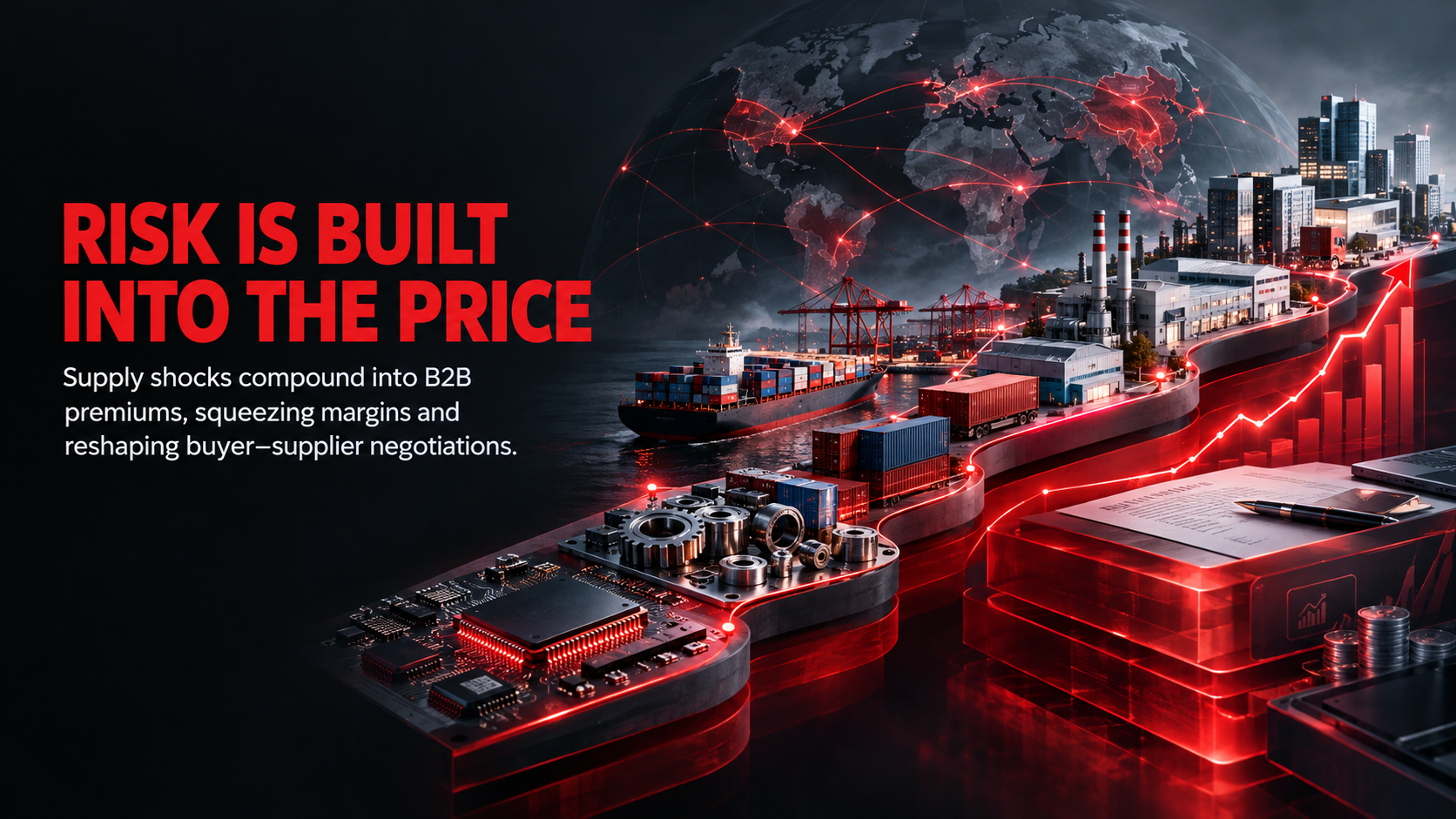
The consequence is the thesis worth holding onto throughout everything below. When suppliers across a multi-tiered value chain simultaneously embed precautionary buffers for geopolitical, financial, supply chain, and operational uncertainty, risk premiums stop being temporary transactional surcharges. They convert into permanently embedded cost baselines across the whole macroeconomic B2B landscape — and once a premium is baked into a baseline, it is extraordinarily difficult to remove, even when the crisis that justified it has long since passed.
From Trailing Cost-Plus to Pricing Ahead of the Shock
Legacy B2B agreements were built on cost-plus logic, and cost-plus is inherently reactive. Prices adjust after realized cost increases materialize in raw materials, direct labor, energy, or freight line items. The formula worked because the underlying data moved slowly and the lag was tolerable. In a hyper-connected industrial ecosystem where a single plant outage can reprice a component category in ten days, trailing cost-plus exposes enterprises to margin erosion velocity that no quarterly review cycle can catch.
Modern commercial leadership has therefore abandoned reactive pricing in favor of forward-looking risk hedging. Suppliers price ahead of potential crises, incorporating the probability and financial impact of future disruption directly into baseline proposals. This is not opportunism by default — some of it is genuine capital allocation against real redundancy — but it changes the negotiation permanently. The question is no longer whether costs went up. The question is how much of an uncertain future each party is willing to fund today.
Deciphering how embedded precautionary costs cascade through complex commercial tiers, and building frameworks to quantify, negotiate, and monetize them, has become the defining strategic challenge for executives who own B2B pricing, risk premiums, geopolitical exposure, and supply continuity.
The Cheapest Component, the Costliest Stop
The clearest way to understand why risk premiums survive is to separate the cost of a part from the cost of not having it. When automotive giants such as General Motors and Toyota were forced to idle assembly lines for weeks over shortages of low-cost microcontrollers, the economic damage had almost nothing to do with the price of the missing chips. It came from the complete interruption of high-margin capital output — trucks and cars that could not be built, dealers who could not be supplied, and revenue that does not wait.
A component worth a few dollars per vehicle halted production worth tens of thousands per vehicle. That asymmetry is the engine of modern risk pricing. Once a buyer has lived through a line-down event, their willingness to pay for allocation priority changes permanently, and suppliers know it. The premium they charge is not attached to the part. It is attached to the buyer’s memory of what happened without it.
This is also why generic percentage surcharges are so tempting and so dangerous. A supplier can claim the same flat uplift across a catalog without ever mapping which SKUs actually carry line-down risk. The buyer, correctly, senses that the premium is being applied to the wrong thing.
Concentration Is the Real Pricing Variable
Structural risk premiums in industrial supply chains are driven less by demand and more by the extreme geographic and corporate concentration of primary inputs. When an entire global industry depends on a narrow set of specialized facilities or sole-source vendors, a localized disruption produces immediate, non-linear price volatility worldwide.
Semiconductors remain the definitive case study. TSMC’s Fab 18 in Tainan, Taiwan, is the world’s premier fabrication facility for cutting-edge microprocessors. It manufactured the A14 chip that powered more than 100 million iPhone 12 units, each chip carrying 11.8 billion transistors etched at nanometric scale. Across a span of mere months, that single fab fabricated well over one quintillion transistors for one product line — a scale of precision manufacturing with no real historical precedent.
The concentration statistics explain the pricing behavior. Taiwan’s fabrication facilities produce roughly 37% of the world’s new computing power each year, and two South Korean technology giants account for about 44% of global memory chip output across DRAM and NAND flash. At the upstream foundation of the entire ecosystem sits ASML, holding a 100% global monopoly on extreme ultraviolet lithography machines. Without ASML’s EUV systems, fabricating sub-7-nanometer logic chips is physically impossible. Any executive pricing hardware in this chain is pricing a dependency, not a product.
The Chokepoint Cascade, Tier by Tier
When strategic single-source dependencies exist, any shock triggers a predictable, multi-tiered pricing cascade. Understanding its stages is the difference between negotiating with data and negotiating with anxiety.
- Chokepoint disruption. A physical event, geopolitical friction, or regulatory intervention hits a concentrated primary supplier. The event itself may be small; its location inside the dependency graph is what matters.
- Input shortage and allocation rationing. Intermediate manufacturers face quotas, spot-market bidding wars, and lead times stretching from twelve to eighteen months. Line-down risk propagates across entire assembly sectors.
- Preemptive risk surcharging. Tier-1 and Tier-2 suppliers insert precautionary margin buffers and capacity reservation fees into proposals to protect their own balance sheets against anticipated procurement spikes.
- Downstream escalation and baseline inflation. Precautionary fees compound across successive commercial layers. What began as a temporary volatility charge becomes a permanently elevated baseline for enterprise buyers.
The compounding is the part most procurement teams underestimate. A 15% buffer added at Tier-3 does not arrive downstream as 15%. It arrives as the input to a Tier-2 buffer, which becomes the input to a Tier-1 margin assumption, each layer applying its own percentage to a slightly larger number. The cascade is arithmetic, not conspiracy, but the result looks the same on an invoice.
The Regulatory Shock That Rewrote Contracts Overnight
Regulation deserves separate attention because it moves faster than physical capacity. When the U.S. Commerce Department added Huawei to its Entity List and tightened export controls, established supply agreements were disrupted overnight. Buyers across the world re-routed supply chains and bid up secondary market capacity within weeks, and the resulting price effects appeared long before any new capacity came online.
Compare that timeline with capital equipment. When ASML experiences component delays or logjams in optics deliveries, the ripple reaches Tier-1 automotive and industrial electronics manufacturers over roughly twelve to eighteen months. During that window, suppliers apply preemptive risk surcharges in the range of 15% to 20% to end customers — long before any physical chip allocation actually drops.
This is the most uncomfortable characteristic of modern risk pricing: the premium arrives before the shortage. Buyers pay for a disruption that may never fully materialize, because the alternative is discovering too late that they are last in the allocation queue.
When the Cost of Capital Becomes a Pricing Input
Risk premiums are not only physical. Macro-financial shifts introduce systemic friction costs that compel suppliers to raise hurdle rates, and the mechanism is straightforward once you follow the money. In The Price of Time, Edward Chancellor details how shifts in interest rate regimes and monetary policy fundamentally alter the price of risk over time.
In low-rate environments, holding substantial safety stock carried negligible working capital penalty. Inventory was cheap to finance, so resilience looked free. In elevated rate regimes, a firm’s weighted average cost of capital rises sharply, and the same buffer becomes an expensive balance-sheet burden. Suppliers must absorb higher holding costs, financing charges, and liquidity risk. To defend target returns on invested capital, commercial leadership raises gross margin floors — which converts elevated interest rates directly into higher B2B price floors.
The chain is worth memorizing because it removes the argument from the negotiation: interest rate inflation raises WACC, which raises inventory carrying cost, which creates balance-sheet liquidity drag, which forces higher gross margin targets, which lifts the price floor. A supplier raising prices because money got expensive is making an economic statement, not a moral one. A buyer who cannot see the chain will assume the worst.
Resilience Is Not Free: The Overhead Nobody Budgeted For
In The Resilient Enterprise, Yossi Sheffi demonstrates that building supply chain resilience requires real capital investment in structural redundancy. Dual-sourcing, localized safety stock warehousing, qualifying alternative vendor networks, maintaining flexible manufacturing lines: every one of these requires ongoing operational expenditure and management attention.
During normal operations, those investments raise unit production costs. Nothing is produced by the second source; it exists so that production continues when the first source fails. Suppliers therefore pass structural resilience overhead to corporate buyers, framing the increase as a continuity premium.
The framing matters more than most sales teams realize. A resilience premium can be justified line by line, because the buyer receives something identifiable: a qualified second site, a reserved capacity slot, a 60-day local buffer. A general market adjustment cannot be justified that way, because there is nothing to point at. Both raise the price. Only one survives a procurement audit.
Logistics Volatility and the Slow Death of Predictable Transit
In The Box, Marc Levinson chronicles how containerized shipping transformed global trade by standardizing transit costs and enabling ultra-lean just-in-time manufacturing. The entire JIT paradigm rested on a quiet assumption: that a container leaving one port would arrive at another on a predictable schedule at a predictable price.
Maritime security risk, regional port congestion, and fuel transition surcharges have eroded that predictability. Transit times extend and become erratic. Long, uncertain lead times tie up capital in inventory that is in transit rather than in production, and they force buyers to abandon lean workflows they spent a decade building.
Suppliers respond by building precautionary margin cushions into long-term agreements to absorb sudden freight rate swings. Note what this does structurally: an operating problem — unpredictable ships — becomes a permanent pricing feature. Even if freight normalizes for two consecutive quarters, the cushion tends to stay, because removing it requires someone to volunteer for the risk again.
The Pass-Through Fight: Suppliers Push, Procurement Pushes Back
As suppliers modify agreements to capture expanding risk layers, negotiations become a contest over cost justification and risk allocation rather than over unit price. The two sides are structurally opposed, and both are behaving rationally.
On one side, the supplier directive is to preserve net operating margins, shift volatility risk downstream, and implement blanket volatility fees that are fast to administer and easy to defend internally. On the other, enterprise procurement enforces open-book cost modeling, imposes benchmark indexing against public indices, and demands contractual audit rights.
The asymmetry is that the supplier needs speed while the buyer needs evidence, and evidence takes longer to assemble than a surcharge letter. That is precisely why un-itemized fees keep appearing: they are designed to arrive before the analysis does.
Fairness as an Economic Variable
In The Strategy and Tactics of Pricing, Thomas Nagle and Reed Holden outline the mechanics governing customer price sensitivity, economic value to customer, and perceived fairness thresholds. Their central finding is deceptively simple: buyers exhibit low price sensitivity when increases are perceived as legitimate, externally driven cost pass-throughs, such as verified commodity spikes. Price sensitivity surges when increases are perceived as discretionary margin expansion dressed as inflation.
Daniel Kahneman’s dual entitlement theory explains the psychology underneath. Buyers hold an implicit belief that they are entitled to the reference price and that sellers are entitled to a reference profit. A price increase that protects the seller’s reference profit against a genuine external cost is accepted as fair. An increase that improves the seller’s profit at the buyer’s expense violates the unwritten contract, even when the absolute number is smaller.
This is why broad, non-transparent supply chain risk fees trigger disproportionate reactions. The buyer is not only calculating cost; they are judging intent. And once intent is judged negatively, procurement stops optimizing price and starts optimizing for supplier displacement.
Anatomy of a Fifteen Percent Surcharge
Consider an enterprise negotiation between a Global 500 industrial manufacturer and a Tier-1 component vendor during annual contract renewal. The vendor submitted a mandatory, across-the-board 15% global supply chain risk fee applicable to all master service agreements, defended by reference to general macroeconomic inflation, elevated maritime freight, and geopolitical volatility in sub-tier component markets.
The buyer’s procurement team rejected the un-itemized fee and invoked contractual audit rights, requiring open-book cost data that mapped realized input shifts across raw materials, direct labor, energy, and freight against independent benchmarks such as the producer price index and the Baltic Dry Index.
The unbundling revealed a substantial gap. Realized raw material inflation came in at 3.2%, verified against commodity indices. Realized inbound freight escalation was 2.1%, verified against maritime index tracking. Total verifiable operational cost increase: 5.3%. The remaining 9.7 percentage points of the requested 15% were discretionary margin expansion.
Armed with that number, procurement did not simply reject the proposal. It restructured the commercial relationship: baseline price adjusted upward by exactly 4.0% to cover verified input inflation; a quarterly price adjustment mechanism tied to the producer price index for industrial components; and, because the initial request had been non-transparent, a competitive secondary-sourcing tender that reallocated 30% of total contract volume to an alternative vendor offering open-book transparency.
The lesson is not that suppliers should never raise prices. It is that un-itemized surcharges destroy more value than they capture. The 9.7-point margin grab cost the vendor 30% of an account, and it taught the buyer that this supplier’s numbers cannot be taken at face value in any future cycle.
When Everyone Charges the Same Risk Fee, Risk Becomes a Commodity
There is a second-order effect that spreads quietly across industries. When precautionary risk surcharges become universal, risk pricing commoditizes. If every vendor in a sector adds an identical, un-itemized uplift without offering tangible operational enhancement, the pricing structure carries no economic information and therefore confers no pricing power.
Differentiation only exists when the premium is attached to something a buyer can verify: guaranteed allocation slots during shortage events, binding lead-time service levels, dedicated regional safety stock, audited tier-N visibility. Without those, the surcharge is simply a price increase, and price increases in a commoditized market invite re-tendering at every renewal cycle.
Sectors that have already traveled this road show the pattern clearly. The first movers capture margin. The fast followers capture a little. The late majority ends up absorbing the reputational cost of a fee the market now treats as padding — and then competes on price in a market where nobody believes the numbers anymore.
The Total Cost of Ownership Paradox
For an enterprise buyer, a premium is economically rational when it directly reduces total cost of ownership during disruption. Paying more per unit for guaranteed allocation, dual-region capacity, or localized safety stock is usually far cheaper than experiencing an extended line-down event.
The arithmetic is brutal in its simplicity. Option A: a unit price of $100, no safety stock, just-in-time flow, standard allocation priority. A three-week factory halt during a disruption event costs $5,000,000 in lost output. Option B: a unit price of $115, a 15% premium, a 60-day local buffer, Tier-1 guaranteed allocation priority, zero line downtime during the same event.
On paper, Option A looks 15% cheaper. In reality, Option A is the expensive choice by an order of magnitude, because the premium is paid on every unit while the downtime is paid in one catastrophic block. Procurement teams that only compare unit prices are not comparing the same thing at all.
This is also where sales teams lose deals they should win. A rep who presents a 15% higher price without framing the avoided downtime is asking the buyer to pay for insurance with no stated payout. A rep who presents the same price alongside the buyer’s own modeled cost of a three-week halt is having an entirely different conversation.
Contracts That Breathe: Index Bands and Risk Corridors
Instead of negotiating static annual pricing or applying disruptive ad-hoc surcharges, contracts can establish dynamic pricing formulas tied to independent market indices. Adjustments trigger automatically when benchmark variation exceeds agreed thresholds, which removes the annual hostage negotiation from the relationship.
The mechanism is simple arithmetic. Adjusted price equals base price multiplied by one plus beta times the percentage change in the benchmark index between signing and the current period. Beta is the verified cost pass-through weight factor — roughly 0.45 for a component whose raw material content is about 45% of price. The buyer can check the math; the supplier does not have to write a letter.
Symmetric risk-sharing corridors add a neutral zone that absorbs minor volatility while protecting both parties against extreme movements. Inside a corridor of about plus or minus 3%, the supplier absorbs input variation without changing unit prices. Between 3% and 10%, cost shifts are split equitably, typically fifty-fifty. Beyond 10%, extraordinary swings trigger mandatory open-book renegotiation.
The symmetry is the point. Most supplier proposals include an upward adjustment clause and no downward trigger. A corridor that moves in both directions is a genuine risk-sharing instrument; one that only ratchets upward is a permanent price increase with extra paperwork. Buyers should treat asymmetric machinery as a red flag, and suppliers who offer true symmetry should say so loudly, because it is one of the few credible signals of confidence in their own cost claims.
Compressed Quote Windows and Productized Continuity
During periods of high raw material or logistics volatility, sales operations compress formal quotation validity windows, shortening firm commitments from legacy 90-day terms to around 14 days. This prevents sellers from locking in unhedged fixed-price commitments immediately before a market swing. It is uncomfortable for buyers trained on long validity periods, and it is honest about what the seller actually knows.
At the same time, resilience itself can be productized. Tiered continuity service levels let buyers choose and pay for their preferred level of supply security. A priority tier carrying roughly a 15% premium might include guaranteed inventory allocation during global allocation events, 60-day localized safety stock reservation, and a binding 48-hour fulfillment commitment. A standard tier keeps baseline pricing with proportional allocation during shortages.
Productizing continuity converts an argument into a menu. The buyer decides how much certainty they want; the supplier stops defending a blanket fee and starts selling a defined outcome. Both parties leave with something they can audit.
Why Spreadsheets Cannot Run a Risk-Priced Deal Desk
Executing dynamic pricing requires account managers and deal desks to have immediate visibility into customer purchase behavior, historical margin pushback, and account-level profitability. Static spreadsheets and legacy CRM objects cannot evaluate complex risk-sharing corridors or detect margin erosion quietly accumulating across thousands of active enterprise SKUs.
The data needed is fragmented by design: ERP transactional history sits in one system, sub-tier supply tracking in another, commodity indices somewhere else entirely, and buyer negotiation behavior exists mainly in the memory of whoever ran the last renewal. Purpose-built commercial intelligence platforms such as Sald.io address this by embedding real-time customer intelligence and AI-driven deal desk workflows directly into sales operations.
- Real-time margin safeguards. The system identifies margin compression across enterprise deals and flags accounts where rising input indices or higher capital carrying costs breach target profitability thresholds — before the quarter closes.
- Procurement pushback analytics. Buyer resistance patterns are tracked across regions and customer tiers, giving deal desks data on account-level price sensitivity and historical acceptance of index-linked structures.
- Value-communication scripts. Reps receive account-specific value metrics for renegotiations, so they can explain total cost of ownership benefits of continuity commitments instead of defaulting to un-itemized discounts.
- Corridor enforcement. Live quotes are monitored against pre-approved risk-sharing parameters, preventing field teams from offering static, unhedged fixed pricing without executive sign-off.
The organizational benefit is not just accuracy. It is that pricing discipline stops depending on individual heroics. When the corridor is enforced by the workflow rather than by a memo, the deal desk stops accidentally selling risk the company never agreed to carry.
Building the Operating Model
Frameworks only matter if someone owns them. What follows is the operating model that commercial leadership teams are converging on when they move from reactive cost-plus to transparent, value-backed pricing.
Map the Dependency Graph Before Mapping the Price
Audit Tier-1 through Tier-N supplier networks to identify sole-source dependencies, geographic concentration, and hardware chokepoints modeled on semiconductor realities: concentrated fab lines, monopolistic equipment suppliers, single-region assembly. A price increase cannot be evaluated without knowing which input, if it stopped, would stop the output.
Replace Ad-Hoc Fees With Index Formulas
Substitute un-itemized risk fees with contractually binding index formulas tied to public benchmarks and symmetric risk corridors that move in both directions. The goal is not to eliminate price movement. It is to make movement predictable, auditable, and defensible to both boards.
Price Continuity as a Feature, Not a Surcharge
Monetize investments in dual-sourcing, localized safety stock, and flexible manufacturing by offering tiered continuity commitments that quantify and reduce the customer’s total cost of ownership during crises. Reliability has a cost and a value; both should appear in the contract.
Give the Deal Desk Real-Time Intelligence
Deploy commercial intelligence tooling that ties pricing authority to live margin data, buyer pushback patterns, and corridor compliance. Negotiation quality improves most when the rep can see the same numbers the buyer will bring to the table.
What Separates the Winners From Everyone Else
In an economy defined by geopolitical shifts, concentrated chokepoints, and volatile capital costs, embedded risk pricing is a permanent commercial reality. Relying on legacy trailing cost-plus models, or on blanket surcharges that arrive without evidence, exposes an enterprise to both margin erosion and relationship damage — often at the same time.
The suppliers who will win the next cycle are not the ones who charge the highest premium. They are the ones whose premium can be explained in three sentences and verified in a spreadsheet: this is what the risk costs, this is what you receive for it, and this is how the number falls when the risk recedes. That combination is rare, and rarity is what pricing power actually is.
For buyers, the parallel discipline is refusing to accept asymmetry. A premium without a downward trigger is a price increase. A surcharge without an index is an opinion. And a supplier who cannot show the chain from input to invoice is asking to be trusted with the buyer’s cost of capital rather than their own.
The strategic takeaway is uncomfortable for both sides. Uncertainty is now a line item, whether or not anyone writes it down. The organizations that write it down explicitly — with formulas, corridors, and auditable thresholds — pay for risk once. The organizations that leave it implicit pay for it repeatedly, in whatever form the next disruption chooses.