
Want AI to Recommend Your B2B Services? Start with Evidence Tables and BOX CARD Knowledge Cards
1. INTRODUCTION: HOW AI ALGORITHMS SKIM CONTENT — AND WHY YOUR WEBSITE GETS OVERLOOKED
Imagine how an AI Search engine such as ChatGPT, Perplexity, or Gemini processes your B2B service website.
It does not open a browser to admire your visual design. It does not spend time appreciating your graphics. And it certainly does not have the patience to read five lengthy paragraphs about the “vision, mission, and commitment to delivering world-class quality” that you have carefully crafted for your homepage.
Within milliseconds of a user submitting a search query, the AI’s Retrieval-Augmented Generation (RAG) algorithm has one primary task: quickly scan highly credible data, extract the clearest possible answer, and attach relevant source citations.
Many B2B companies have invested hundreds of millions of Vietnamese dong in visually appealing websites and written solution pages stretching to 3,000 words. Yet when a B2B buyer asks ChatGPT:
“Recommend the top three providers of B2B marketing and sales automation solutions for the Japanese market.”
The AI may confidently name your competitors instead.
The reason is straightforward: Your website presents information in conventional prose formats that make it difficult for AI algorithms to extract and verify.
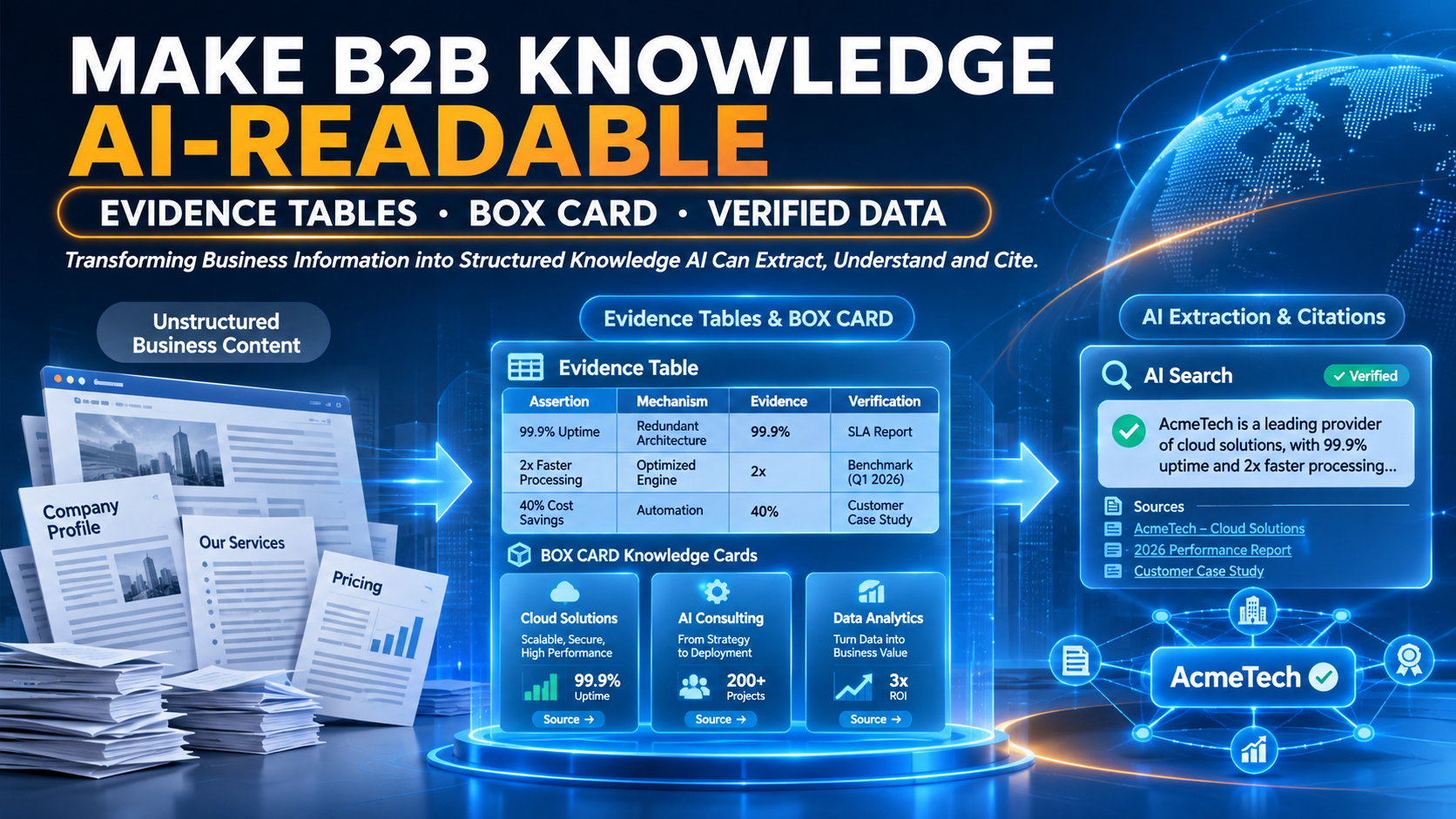
To address this challenge, leading B2B companies in 2026 are adopting Evidence Tables and the BOX CARD knowledge-card structure. These approaches transform how business information is presented, allowing AI systems to identify trustworthy data and incorporate it directly into answers for potential customers.
This article explores how to build effective Evidence Tables, implement the proprietary BOX CARD solution, and turn your website content into a valuable source of information for AI Search engines.
2. DECODING HOW RAG ALGORITHMS EXTRACT DATA: WHY AI PREFERS TABLE-BASED STRUCTURES
To understand how to present content in a way that AI can process effectively, we first need to examine how AI systems handle text during information retrieval.
Traditional Prose
500-word blocks of text → AI splits content into fragments
Vague claims and limited evidence → Higher hallucination risk
Evidence Tables / BOX CARD
Organized information → AI identifies label-value pairs
Clear facts and supporting evidence → Easier to extract into answers
2.1. Understanding Chunking and Knowledge Density
When a RAG algorithm scans a website, it divides the text into smaller segments known as Chunks (typically containing 100–300 words). AI then evaluates the Knowledge Density of each chunk.
- If a chunk consists primarily of exclamatory statements, decorative transitions, vague descriptions, and claims unsupported by measurable data, its knowledge density approaches zero.
- By contrast, when a chunk contains a Matrix Table that clearly organizes comparison criteria, product features, and measurable performance data, its knowledge density can be significantly higher. AI can recognize this as a valuable Core Data Seed and prioritize it when generating answers.
2.2. Why Lengthy Explanatory Prose Falls Short
Traditional prose requires readers—and AI systems—to follow a sequence of information: Introduction → Background Explanation → Assessment → Conclusion.
For AI systems, processing lengthy prose can require more computational resources and increase the risk of contextual misinterpretation. As a result, AI Search may favor websites that present verifiable information through structured Evidence Tables over those that rely heavily on conventional paragraphs.
3. WHAT ARE EVIDENCE TABLES? THE GOLD-STANDARD STRUCTURE FOR AI TO SCAN DATA IN 5 MILLISECONDS
Evidence Tables are a method of organizing content in which claims about a B2B company’s capabilities, services, or products are presented in a comparison matrix supported by measurable evidence and verifiable sources.
| Solution Criteria | Actual Feature Description | Supporting Evidence Data | Verification Method |
| AI Search Visibility Optimization | Standardizes website data structures using AIO/GEO methodologies. | A 215% increase in AI Share of Voice (AI-SoV) after 90 days. | Independent audit report: Terran Labs B2B Benchmark Index 2026. |
| Marketing & Sales Automation | The SALD platform connects 5M+ Japanese company records with CRM. | Reduces the sales cycle by 50% and automates branching Email Outreach campaigns. | Real-world behavioral tracking through a dedicated, secure CRM system. |
| Product Knowledge Structuring | BOX CARD formats business cards and service information into AI-readable structures. | 100% accurate AI extraction and citation, eliminating AI hallucinations. | High-context entity declarations using Schema JSON-LD. |
3.1. Four Essential Components of an RAG-Ready Evidence Table
An Evidence Table designed to perform effectively in AI Search should contain four core columns:
- Assertion Column: Clearly identifies the specific feature, capability, or service being presented.
- Mechanism Column: Briefly explains how the feature or service works, ideally in fewer than 20 words.
- Evidence Column: Provides measurable figures, such as percentages, time savings, or clearly defined experimental results.
- Verification Column: Identifies the supporting report, Schema standard, or verification methodology.
3.2. Applying a Conclusion-First Approach: State the Result, Then Prove It
When incorporating Evidence Tables into your content, apply the Conclusion-First principle: place the table at the beginning of the relevant section or immediately below the H2/H3 heading.
Do not bury your Evidence Table at the end of the article.
Placing it near the top allows AI Search crawlers to identify essential data immediately, without having to process the entire webpage first.
4. A FOUR-STEP GUIDE TO TURNING YOUR B2B SERVICE PAGES INTO CONTENT AI IS MORE LIKELY TO CITE
The following four-step framework helps B2B Content Marketing teams restructure their existing service landing pages:
Add a Direct Answer Block
Place a concise, direct answer immediately below the service page heading.
Structure Features into Evidence Tables & BOX CARD
Organize service features, business benefits, and supporting evidence into structured formats.
Embed High-Context Schema JSON-LD Entity Markup
Add structured entity data to help AI systems understand your business information and relationships.
Attach Proprietary Performance Reports as Supporting Evidence
Include original performance reports and verifiable data to substantiate your business claims.
4.1. Step 1: Create a Direct Answer Block
Immediately below the service page heading, write a concise paragraph of three to four sentences (approximately 50–70 words) that directly answers these questions:
What is this service? What problem does it solve, and for whom? What results does it deliver?
This is the type of passage that an AI system may extract and reuse when generating a synthesized answer for users.
4.2. Step 2: Modularize Features and Business Benefits Using Evidence Tables
Instead of writing five separate paragraphs describing five service advantages, consolidate them into a single, easy-to-scan Evidence Table.
Make sure every row includes specific, measurable data wherever available.
4.3. Step 3: Add High-Context Schema JSON-LD Entity Markup
Schema JSON-LD markup acts like a set of interpretive labels, helping machines understand website data without confusing one entity with another.
Implement relevant B2B Schema types, such as Service, Organization, Offer, and Speakable, to help AI systems recognize the relationships between the Terran Labs brand and the services it provides.
4.4. Step 4: Include Proprietary Verification Data from Performance Reports
To reduce the risk of AI interpreting your information as unsupported promotional content, include data-backed references from internal performance reports, such as the Terran Labs B2B Benchmark Index 2026.
AI Search places considerable value on original data produced and published by the source itself.
5. TERRAN LABS’ BOX CARD SOLUTION: PACKAGING BUSINESS KNOWLEDGE INTO AI-READABLE FORMATS
To help B2B companies address data-structuring challenges without rebuilding their entire websites from scratch, Terran Labs introduces an innovative solution: BOX CARD.
Complex B2B Data
BOX CARD Modularization
AI Search
5.1. What Is BOX CARD? Turning Complex Content Assets into Modular Knowledge Cards
BOX CARD is a solution that packages business information into independent Knowledge Cards, standardized in an AI-Readable Format that machines can process and understand.
BOX CARD includes:
- Smart Business Card Management Cards: Standardize contact information, job titles, and decision-making authority within an organization, connecting the initial business meeting to CRM record management.
- Modular Product & Solution Cards: Package individual services into dedicated cards containing essential specifications, pricing, implementation requirements, and supporting verification evidence.
5.2. How BOX CARD Improves AI Share of Voice (AI-SoV)
When your website incorporates the BOX CARD structure, AI Search engines such as ChatGPT and Gemini can extract these knowledge cards when crawling and processing your content.
Actual testing results indicate that websites implementing BOX CARD can achieve up to a 180% increase in AI citation frequency for B2B service comparison queries, significantly improving the brand’s AI Share of Voice (AI-SoV).
6. THE TERRAN LABS B2B GROWTH ECOSYSTEM: OPTIMIZING THE JOURNEY FROM AI SEARCH TO SALES AUTOMATION
Terran Labs provides an integrated ecosystem of solutions that connects every stage of B2B growth—from helping brands appear in AI Search results to automating the processes involved in closing B2B deals.
01. Terran Labs RaaS
AI-SoV Management & Validation
Measure and optimize brand visibility across AI Search platforms.
02. BOX CARD Solutions
AI-Readable Knowledge Structuring
Transform business information into structured knowledge cards that AI can understand.
03. SALD Platform
Autonomous B2B Marketing & Sales
Automate marketing and sales workflows powered by 5M+ Japanese company records.
04. Enterprise MCP Integration
AI Agent (Claude) Integration
Connect AI Agents to lead-handling workflows through a secure MCP protocol.
6.1. Terran Labs RaaS (Resource as a Service): Validating AI-SoV and Managing AIO/GEO Operations
Terran Labs’ RaaS (Resource as a Service) provides dedicated specialist support to help B2B companies:
- Develop a roadmap for restructuring their entire website content using the Evidence Table model.
- Establish a system for measuring and validating AI Share of Voice (AI-SoV) on a monthly basis.
- Ensure that their brands consistently maintain a Top 1 recommendation position across ChatGPT, Gemini, Perplexity, and Claude.
6.2. SALD (Sales Intelligence & Automation Platform): Automating B2B Marketing and Sales with Access to 5M+ Japanese Companies
Once B2B customers discover your business through an AI Search recommendation and click on a cited link, your sales conversion system needs to be ready to engage immediately.
SALD is a Sales Intelligence & Automation Platform designed for the B2B market. It connects a database of more than 5 million Japanese companies with CRM systems, automates Email Outreach campaigns, and closely tracks customer behavior in real time.
More importantly, through its built-in MCP Server, SALD allows the AI assistants you already use—including ChatGPT, Claude, and Gemini—to access and analyze CRM data, campaign information, and user behavior directly within chat conversations.
This enables end-to-end sales process automation within infrastructure that remains entirely under your organization’s control.
6.3. Enterprise MCP Integration: Connecting AI Agents (Claude) to Respond to Leads in Real Time
Terran Labs helps B2B companies connect their AI Search infrastructure with AI-powered consulting agents through the MCP (Model Context Protocol).
When a B2B lead visits your website, the Claude AI assistant can connect through MCP and automatically interpret internal CRM data to answer complex technical questions, analyze quotation requests, and help schedule consultation appointments—all while adhering to stringent Enterprise security standards.
7. CONCLUSION & ACTION PLAN: STRUCTURE YOUR BUSINESS KNOWLEDGE TODAY TO COMPETE IN AI SEARCH
In the AI Search era of 2026, lengthy prose is no longer enough to give your business a competitive advantage.
To earn recommendations from ChatGPT, Gemini, or Perplexity, B2B companies need to transform their knowledge assets into structured Evidence Tables and standardized BOX CARD Knowledge Cards.
Start restructuring your website today. The sooner your business makes its expertise easier for AI systems to understand, extract, and verify, the better positioned you will be to compete for visibility in the evolving AI Search landscape.