
AI-Native Enterprise: Beyond Software and Automation
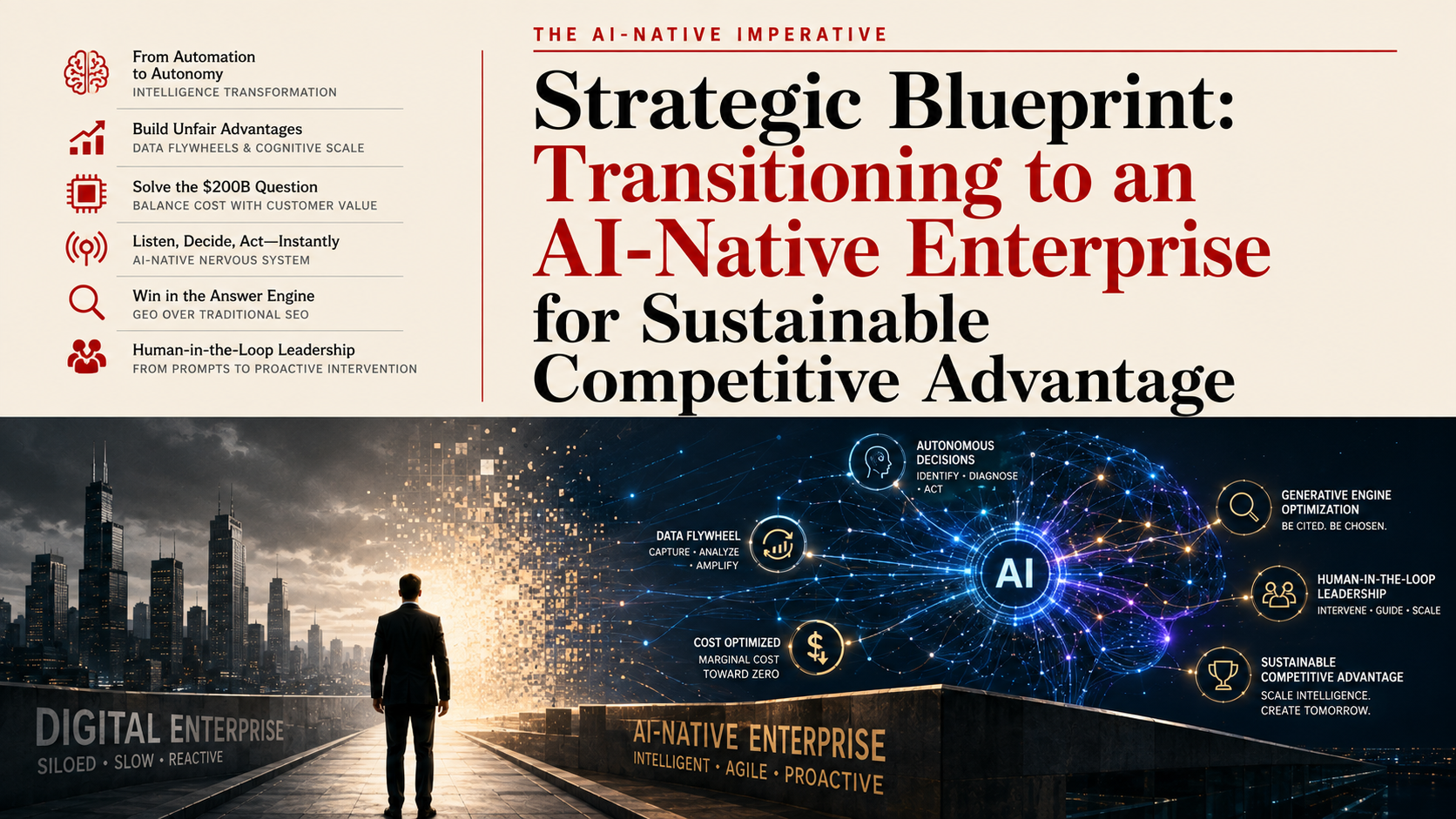
For two decades, the enterprise playbook was simple: digitize everything. Move paper into software, put workflows into the cloud, automate repetitive tasks, and measure everything on a dashboard. That playbook has not failed exactly, but it has stopped being enough. A new strategic shift is under way, and it is not another layer of digital tools. It is a move from automation to autonomy, from software that supports people to intelligence that performs work.
The old distinction between digital and physical used to define competitiveness. The new distinction is between enterprises that only digitize their current way of thinking and enterprises that rebuild themselves around machine intelligence. This is why the most useful conversation for executives right now is not about AI adoption. It is about the transition to an AI-native enterprise, an organization whose structure, workflows, and information systems assume that intelligent agents are core employees, not experimental features.
The Digital Era Is No Longer Enough
Digital transformation was never wrong. It was incomplete. Moving from paper to pixels improves efficiency, but it does not change the fundamental shape of the organization. The same humans still carry information between departments. The same sales team still passes leads to marketing. The same managers still make decisions after delays. Digital tools make those old processes faster; they do not make them unnecessary.
The next phase changes that equation. One strategic briefing frames the shift as the end of digital transformation and the beginning of intelligence transformation. In this view, the speed of market change is no longer linear. It is massive, accelerating, and exponential. Geopolitical events, technology releases, and customer expectations now move in days, not quarters. The briefing points to a striking example: when a frontier Anthropic model was released, export restrictions from national policymakers followed within about three days. That is not a normal product cycle. That is a strategic shock wave.
Leaders who think they still have a two-year window to respond are operating with an outdated clock. The collapse of decision time means the enterprise itself must sense and act faster than its human hierarchy can. Traditional software companies are aiming at a global software market measured in hundreds of billions of dollars. AI-native systems aim at something far larger: the labor market itself, because they can take on expertise-intensive tasks once reserved for humans. The strategic implication is not simply that jobs will change. It is that the cost of intelligence is moving toward zero, so the old moat of domain expertise is beginning to dissolve.
Automation and Autonomy Are Different Species
It is tempting to see AI-native as an upgrade to robotic process automation. That comparison misses the deeper change. Automated systems are rule-based. They follow a script until an exception occurs, and then they wait for a human to decide. Autonomous systems are generative. They can identify a problem, diagnose what is happening, and propose or even implement a solution before a human would have finished reading the first status report.
The difference shows up in economics. Automation is linear because every new workflow requires a new set of rules. Autonomy is exponential because an agent can learn from an expanding set of situations without adding headcount. Automation tends to reduce the cost of existing tasks. Autonomy changes which tasks are possible. For enterprises, that distinction matters because the goal is not to make the same organization slightly faster. The goal is to design an organization that can scale expertise without scaling people.
In practice, this means moving away from the assumption that every piece of knowledge must travel through a human brain. An AI-native organization treats information as a circulating asset. It captures signals continuously, analyzes them immediately, and launches action automatically. When a signal is ambiguous, a human can step in, but the human should not be the default transport mechanism for every piece of data.
The Flywheel That Creates the Real Unfair Advantage
Most companies talk about data as a strategic asset, but they treat it like inventory: collect it, store it, and hope to use it later. AI-native organizations treat data differently. They create a knowledge flywheel in which information circulates, improving every step of the business. Each customer conversation, product signal, market shift, and sales interaction becomes fuel for the next action.
The flywheel begins with ingestion. Every relevant communication and market signal is captured in real time, not because someone wants a perfect archive, but because the organization wants to see patterns as they emerge. Next comes analysis. AI systems look for buying intent, dissatisfaction, momentum, and risk. A human might miss a subtle change in tone or a repeated question. An agent can detect those small signals and treat them as triggers. Then comes action. The system does not simply create a report. It responds, sometimes by generating a proposal, sometimes by alerting a salesperson, sometimes by beginning a prototype.
That closed loop creates what the briefing calls an unfair advantage. A competitor with a traditional digital structure has to hold meetings, assign tasks, and move information through organizational layers. An AI-native structure can bypass all of that because knowledge moves from detection to response without waiting for a human gatekeeper. The advantage is structural, not motivational. It cannot be copied by buying the same software. It has to be built into the way the enterprise operates.
The example of Matthew Griffin, a former IBM executive cited in the strategic briefing, illustrates the power of this model. He used agentic AI principles to grow a business unit from about $2 million to $350 million in sales, a roughly 16,000 percent increase, while operating with a very small team. His unit was able to outmaneuver much larger incumbent competitors such as HP and Atos. The difference was not that his team worked harder. It was that the team had access to a cognitive scale that looked like a global corporation.
Small Teams Now Have the Reach of Giants
The idea of a thousand-person sales force has been the default answer to market ambition for decades. AI-native strategy challenges that assumption. A small team, perhaps even two or three people, can command a level of intelligence, speed, and knowledge access that would have required an entire enterprise in the past. The reason is not that AI replaces human creativity. It is that AI amplifies human attention across many more conversations, documents, and decision points than a human alone could monitor.
Agentic AI is not just a language model. It combines social intelligence, emotional intelligence, and action intelligence. It understands context, detects shifts in tone, and follows through on next steps. These agents have access to far more information than any single human can hold, and they do not sleep. When a major AI model enters the legal domain, for example, the market reaction can be rapid and severe. The briefing notes that some large law firms lost about 20 percent of their market value in a short period because investors understood that legal expertise, once considered a protected profession, was becoming accessible through AI. That is the kind of shock every expertise-based industry may face.
Strategic amplification is therefore a better phrase than replacement. The goal is not to remove the human expert from the loop. The goal is to give that expert the leverage of an entire organization. A single product manager can brief an agentic system, and that system can generate variations, test assumptions, draft communication, and coordinate handoffs. A single salesperson can walk into an account with deep intelligence about every stakeholder, past conversation, and likely objection. The three-person team becomes a thousand-person force.
The $200 Billion Question No Executive Can Ignore
The economics of AI are not automatically beautiful. Sequoia Capital has framed the challenge as the $200 billion hole. The phrase captures an uncomfortable reality: the cost of building AI infrastructure is massive, but the revenue generated by that infrastructure is still being questioned. For every dollar spent on a GPU, roughly another dollar is spent on energy. If the industry pours $100 billion into data centers, those data centers need to produce something close to $200 billion in lifetime revenue at a 50 percent margin just to reach breakeven. Absent a clear path to customer value, spending on AI becomes a capital incinerator.
This does not mean AI is overhyped. It means the focus must move from the infrastructure conversation to the value conversation. The winning enterprise will not be the one with the largest cluster of GPUs. It will be the one that ties every compute dollar to an outcome someone is willing to pay for. The executive question is no longer whether AI works. The executive question is where AI creates value that customers can feel.
Where Customer Value Actually Shows Up
The strategic briefing offers a useful value-to-cost framework. The first and most obvious source of value is marginal cost reduction. When AI can help generate a prototype, write a piece of software, or simulate a new material, the cost of the first unit falls sharply. Innovation no longer needs a large budget and a long timeline. The ability to iterate quickly becomes more important than the ability to fund a big team.
The second source is inference-driven sales. Too many deals die not because the solution is wrong, but because the timing is wrong. A prospect shows interest, and then nothing happens until the internal process catches up. AI can analyze the psychology of a deal in real time and tell the team what is going on beneath the surface. It can detect who is reading, who is hesitating, and what would move the conversation forward. The briefing mentions that deals often die because of lag between intent and response, and that gap can be as large as 30 percent. Closing that gap is a revenue strategy, not a support function.
The third source is hyper-personalization. In the past, personalized marketing meant segmenting an audience into a few groups and changing the greeting on an email. In an AI-native world, personalization can happen at the individual level. Every decision maker can receive content that reflects their industry, their recent behavior, their concerns, and their language. The result is not just higher engagement. The result is dramatically better conversion. The briefing estimates that visitors coming from AI-powered search convert at rates four to five times higher than traditional search visitors. That happens because the visitor arrives with clearer intent and a stronger match to the solution.
The Listening System Is the New Nervous System
An AI-native organization needs more than smart internal tools. It needs a sensory layer that can hear what the market is saying before competitors do. Listening systems are designed to monitor both public signals and private interactions. They go beyond social media monitoring. They look for intent, context, and the small clues that reveal whether a major deal is advancing or stalling.
The strategic briefing describes how IBM used a listening system to win a Walmart opportunity. Walmart is a massive buyer of cloud services, but one executive had publicly stated a dislike for public cloud. A traditional digital sales team, trained to sell its flagship product, might have pushed public cloud anyway and lost credibility immediately. IBM paid attention to the public signal, understood the constraint, and pivoted to a hybrid or private cloud message. That pivot, informed by a simple listening loop, changed the outcome of the deal.
Listening systems work best when they are connected to action. It is not enough to capture a signal and store it for next quarter. The AI-native enterprise turns the signal into action instantly. Consider a buyer who takes a photograph of a slide during a presentation. A traditional team might not even register that gesture. An AI listening system can interpret it as strong buying intent. It can generate a tailored proposal, align the pitch with the buyer’s psychological profile, and send the contract for review. Legal agents can inspect that contract and return it in minutes. The human seller stays in control but no longer carries the administrative burden. The entire loop closes while the buyer still feels the momentum of a live conversation.
From Search Bars to Answer Engines
The external battleground has also shifted. For decades, winning meant ranking first on Google. The problem is that the user journey has changed. More and more buyers are starting with ChatGPT, Perplexity, Gemini, and other answer engines. Instead of clicking through blue links, they ask a question and receive a synthesized answer. If the enterprise is not present in that answer, all of its search engine optimization work becomes invisible.
The shift is not merely a change in user interface. It is a change in how content is consumed. Traditional SEO optimized for crawlers and ranking algorithms. Generative engine optimization, or GEO, optimizes for retrieval-augmented generation. The AI engine pulls small chunks of content, evaluates their accuracy and relevance, and assembles a response. The metric of success is no longer domain authority or backlinks alone. It is citability: whether a specific statistic, definition, or data point is trustworthy enough to be used in an answer.
Research in the briefing suggests that organic search click-through rates have dropped significantly because of zero-click results. AI summaries mean users no longer need to visit a website. Yet this is not all bad news for content creators. Visitors who arrive from an AI search engine tend to convert at much higher rates. The reason is simple: they arrive with intent already refined. They have compared options, read the summary, and chosen your organization as the best place to continue. That warm traffic is worth far more than cold display advertising.
Writing for Machine Readers
If AI agents are becoming the first readers of corporate content, content itself must be machine-legible. The briefing offers a useful checklist. First, write quotable definition sentences at the top. Content that follows a clear structure, such as X is Y in the opening paragraph, gives an AI engine an easy source to cite. This does not mean writing like a robot. It means making your intelligence easy to discover and reuse.
Second, include cited statistics. Numerical data creates credibility, but only when it is connected to a source. Content that references clear studies and data points is far more likely to be lifted into an AI answer. The briefing cites research suggesting this approach can increase AI citation rates by as much as 40 percent. A claim without a number feels thin. A number without a source feels risky. Both need to be present.
Third, obey a clear information hierarchy. Use headings that mean something outside the context of the full page. Write short, semantically complete paragraphs that could be extracted and understood on their own. If a paragraph depends on a long introduction that appeared earlier, an AI engine may discard it. The best content for AI is structured the same way as the best content for people: clear, specific, and self-contained.
The Leadership Shift From Prompt Boxes to Proactive Agents
Leadership in an AI-native enterprise requires more than learning how to write better prompts. The real skill is designing a hierarchy of agency. At the low end, an employee identifies a problem and asks a manager what to do. That may have been acceptable in a slower era, but it is now too slow. At the high end, an employee or an AI agent identifies the problem, researches it, diagnoses the cause, implements a solution, and then asks for human approval only at the final step. That is the S-tier level of agency, and it is the operating model of the intelligence era.
Human oversight is still important. But it should be an escalating exception, not a daily bottleneck. If every AI-generated output needs human review before it can leave the building, the organization is still running at human speed. The key is to define the boundaries where human approval is genuinely necessary and allow autonomous action everywhere else. This shifts the culture from control to trust, but it is trust built on observable outcomes, not on hope.
The practical transition usually begins with recording. During the first month, the most useful step is simply to capture every meeting, conversation, and decision. This is not surveillance. It is the creation of a shared memory that AI can learn from. Once those records exist, the organization can identify which behaviors and patterns lead to success. It can compare senior performers with junior ones and see where the real gaps lie.
From Captured Conversations to Autonomous Knowledge Circulation
After the organization has started building its memory, the next question is measurement. Two metrics matter in the early stages. First, the speed of updating the sales activity system: if a deal record is not updated within twenty-four hours, the information is already old. Second, the rate of AI utilization: how many deals or decisions are being touched by AI tools. These metrics may feel operational, but they are strategic. They reveal whether the organization has truly crossed the line from digital records to intelligent workflow.
Once those habits are in place, the flywheel begins to turn autonomously. Instead of waiting for a director to share best practices in a quarterly meeting, the system recognizes which patterns are working and distributes them across the firm. Successful outreach language from one region becomes available to every salesperson. A clever negotiation sequence used in one account is adapted automatically for another similar account. This is what the briefing means by autonomous knowledge circulation.
This approach also changes the relationship between organizational size and intelligence. Many companies hit a limit when they reach roughly one hundred and fifty people, the scale often called Dunbar’s number. Beyond that, informal coordination breaks down. Information gets trapped in silos. The cost of communication grows faster than revenue. AI-native structures can bypass that wall because they do not depend only on human relationships to transfer knowledge. The organization can reach a billion-dollar valuation with a surprisingly small team because the knowledge circulates through agents instead of through meetings.
The Strategic Mandate Is Not Incremental
The temptation of every new technology is to use it as a marginal improvement. AI can write better emails, summarize meetings, and update dashboards. Those uses are valuable, but they are not the full story. The real opportunity is a step-change in how value is created. An AI-native enterprise is not a more efficient version of its old self. It is a different kind of competitor.
The strategic briefing encourages executives to move from automation to amplification. Instead of asking how many jobs AI will eliminate, ask how much one person can accomplish when AI is fully embedded in their workflow. The goal is to turn every employee into a super-employee who can move across disciplines, connect previously disconnected domains, and produce work at a level that once required entire departments.
The second directive is to treat data as the core asset. The flywheel cannot spin without fuel, and that fuel is the record of every interaction. Every meeting transcript, every customer response, every failed attempt and successful adjustment should be captured. Enterprises that hoard clean data but do not circulate it will fall behind enterprises that move imperfect knowledge quickly and improve it with feedback.
The third directive is to build for agents. Corporate information is no longer consumed only by humans. AI agents are now reading websites, contracts, help center documents, and sales collateral. The content strategy must be designed for those agents first and for human readers second. If an agent cannot understand what your company does and why it matters, the human will never arrive at your answer.
The future will belong to organizations that make this shift before they are forced to make it. The original strategic brief predicts that the pace of intelligence will continue to accelerate, and it anticipates the arrival of extremely powerful machine intelligence within the next decade. That prediction may or may not be exact, but the direction is clear. The era of digital enterprises that merely use software as a layer on top of old org charts is over. The era of intelligence enterprises, in which knowledge moves instantly, autonomously, and continuously, has started. The advantages available now will not wait for later. The only question that matters is whether your enterprise will design its nervous system for the new reality or hope that automation will be enough. The intelligent action is to start building the new operating model today.