
The Complete Guide to Entering the Japanese B2B Market as a Foreign Company
1. Introduction: The High-Stakes Allure of the Japanese Market
Entering the Japanese B2B market represents what Geoffrey Moore, in the seminal third edition of Crossing the Chasm, identifies as a “high-value chain” opportunity. For global companies, Japan is not merely another geographic territory to be checked off a global expansion list; it is a sophisticated, dense, and deeply rewarding ecosystem where “discontinuous innovations”—products that require the user to change their behavior or modify their existing infrastructure—can lead to massive, sustainable wealth. Conversely, for those who misread the market, it leads to a devastating “wailing and gnashing of teeth.”
The allure of Japan is akin to what Moore describes as the “siren lure of a legitimate get-rich-quick opportunity.” With the world’s third-largest economy and a corporate culture that prizes long-term stability and high-quality partnerships, the potential for a “first-mover advantage” is immense. However, the reality for many foreign entrants is a series of failed attempts to join what Moore calls the “kingdom of the elect.”
Success in a home market, such as the United States or Europe, often creates a “high-tech marketing illusion.” Executives frequently fall into the trap of believing that because their product is “feature for feature” superior to local competitors, it will naturally find a foothold in the Japanese mainstream. This is a fatal misconception. In the high-stakes world of Japanese B2B sales, technical brilliance is merely the table stakes. The real battle is psychological and structural.
The central thesis of this guide is that success is never guaranteed by previous victories in other markets. In Japan, the transition from an initial “blip” of success with early adopters to a “predictable revenue engine” (as defined by Aaron Ross) requires crossing a “Chasm.” This Chasm is the graveyard of disruptive technologies. it exists between the visionary early adopters, who are willing to take risks on new technology for a strategic leap, and the pragmatic mainstream buyers, who dominate the Japanese business landscape and demand well-established references and “evolution, not revolution.”
Our goal is to provide a comprehensive framework for building a predictable revenue machine in Japan. To do so, we must move away from the “eccentric marketing genius” often celebrated in Silicon Valley and toward an “informed consensus.” This document serves as the strategist’s roadmap to navigating the specific psychographics of the Japanese B2B buyer and ensuring your company does not become another “body in the chasm.”
2. Is Japan the Right Market? Evaluating the Strategic Fit
Before a single yen is spent on a Tokyo office, a company must determine if Japan is currently “ripe” for its specific technology. As Moore notes in Crossing the Chasm, every technology has a “window of opportunity.” In high-tech, being right but being too early is indistinguishable from being wrong. If a company loses its momentum during the entry phase, it can be overtaken by a competitor or rendered obsolete by a newer emerging technology—a “day in the sun” that ends before the first mainstream sale is even made.
The CEO’s primary mandate during the pre-entry period is to husband resources with ruthless discipline. Japan is one of the most expensive markets in the world to penetrate, not just in terms of capital, but in “organizational stamina.”
Strategic Fit Checklist for Executives
- Market Opportunity vs. Complexity: Does the potential profit margin justify the significantly higher costs of support, localized R&D, and the “Whole Product” requirements unique to Japan? As noted in Crossing the Chasm, if the profit-margin advantage during the middle to late stages isn’t clear, the venture is a gamble, not a strategy.
- Continuity of the Solution: Is your product a “sustaining innovation” (a simple upgrade to a Japanese workflow) or a “disruptive innovation” (requiring a fundamental change in behavior)? As Moore warns, disruptive innovations face a much harder path to mainstream acceptance because they break the existing infrastructure.
- Resource Husbanding: Do you have the financial and organizational “stamina” to survive the “lean chasm period”? This is the time when the early market (visionaries) has been exhausted, but the mainstream market (pragmatists) has not yet opened. Many companies ramp up spending right as they hit the chasm, leading to a “disastrous ramp-up” of expenses without corresponding revenue.
- Reference Availability: Can you provide the “well-established references” that the Japanese pragmatic majority demands? A Japanese pragmatist will rarely, if ever, accept a U.S.-based reference as valid for a Japanese workflow.
- Whole Product Capability: Are you prepared to deliver the “complete offer”? This includes not just the software, but the local support, the partner’s reputation, and the seamless integration into the Japanese IT ecosystem.
- The “Window of Opportunity” Assessment: Are you entering while the market is still “flush with enthusiasm,” or has the “bandwagon effect” already begun for a competitor?
3. Decoding the Japanese B2B Adoption Curve
The Technology Adoption Life Cycle is a bell curve that describes the market penetration of any new technology. In Japan, understanding this curve is the difference between enlightenment and disillusionment. The segments are distinguished by “psychographic profiles”—a combination of psychology and demographics that determines how they respond to innovation.
Innovators: The Japanese Technology Enthusiasts
In the Japanese context, these are the “gatekeepers.” They are often found in the R&D departments of major conglomerates (Keiretsu) or the technical leads of high-growth startups. According to Crossing the Chasm, these techies:
- Want the “truth” without “marketing hype”: They see right through fancy image advertising. To reach them, you must provide factual, dense technical documentation.
- Prioritize Architecture: They are more interested in how the product is built than its immediate business profit.
- Are Low-Maintenance but Low-Profit: They will spend hours “debugging” your product for the sheer pleasure of exploring its properties. However, they have little budget and even less organizational power.
- Strategic Role: Their role is to provide the technical validation that reassures the next segment that the product “actually works.”
Early Adopters: The Visionaries
Visionaries in Japan are the high-level executives (often “Department Heads” or Bucho) who seek a “strategic leap forward.” They are not interested in incremental improvements; they want to utilize your technology to gain a massive jump on their domestic competitors.
- The “Dangerous” Buyer: Moore notes that visionaries are dangerous because they demand extreme customization. In Japan, this often manifests as a demand for unique features that satisfy one specific company’s workflow but make the product unmarketable to anyone else.
- The Bridge: They are your “Lighthouse Accounts.” They provide the first major checks, but they do not represent the mainstream.
The Early Majority: The Japanese Pragmatists
This group is the “heart of the market.” They represent roughly one-third of the total adoption cycle and provide the real opportunity for wealth. In Japan, pragmatists are the backbone of the B2B sector.
- Psychographic Profile: They are driven by “practicality” and “evolution, not revolution.” They hate “discontinuity.”
- The Reference Requirement: As Moore explains, they will not buy until they see “well-established references.” In Japan, this is the “Catch-22”: They only trust references from other pragmatists within Japan.
- Risk Mitigation: They want to know that your company will still be in Japan ten years from now. They are buying a “productivity improvement” for existing operations, not a “change agent.”
The Japanese Chasm: Wider and Deeper
The “Chasm” in Japan is significantly wider than in Western markets due to the high value placed on consensus and risk mitigation. The Japanese pragmatist is incredibly wary of being the first to adopt a “disruptive” technology. The transition from the “Early Market” (Innovators + Visionaries) to the “Mainstream Market” (Pragmatists) is where most foreign companies fail. They mistake the initial “blip” of interest from a few visionaries for a “smooth ramp-up,” leading to the “high-tech marketing illusion.”
4. Choosing the Strategic Point of Attack: Entry Models
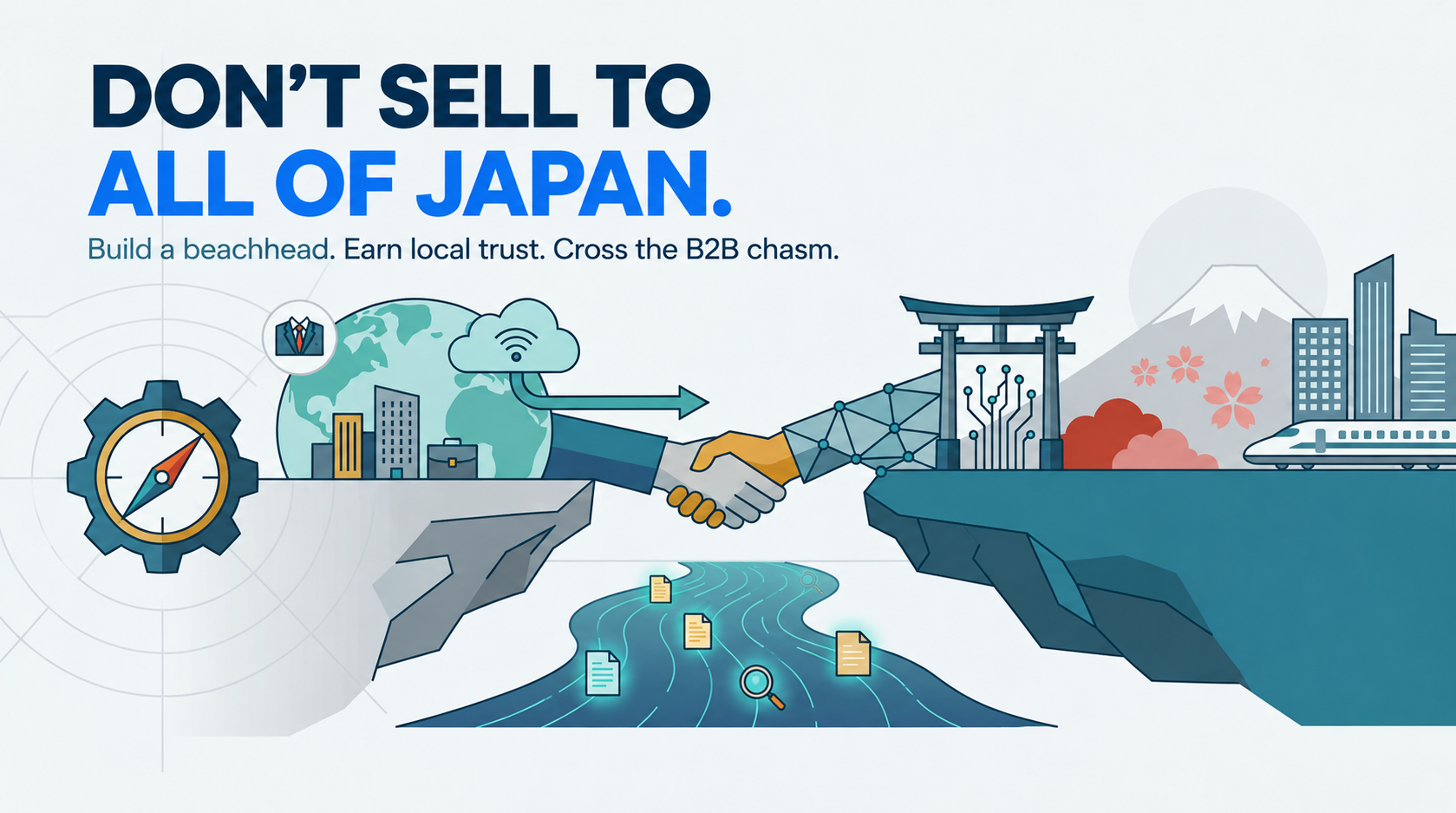
To cross the chasm in Japan, a company must adopt Moore’s “D-Day Analogy.” You cannot attack the whole Japanese market at once; your “Invasion Force” is too small, and your resources are too limited. You must focus your “Point of Attack” on a specific niche—a “beachhead”—to establish a reference base.
The Beachhead Mandate
The goal of the beachhead is not immediate volume; it is to secure a 100% “Whole Product” solution for a specific group of customers who have a common set of needs and reference each other. If you win a bank, a car manufacturer, and a hospital, you have not won three segments; you have won three isolated customers who cannot reference each other, and you will stay in the chasm.
Comparison of Japanese Entry Models
| Entry Model | Pros | Cons | Strategic Use Case |
| Direct Sales | High control over “truth-telling” and architectural messaging. | Prohibitively high cost; extreme difficulty navigating Ringi networks without “local face.” | Best for the “Early Market” (Innovators/Visionaries) where high-touch technical interaction is required. |
| Local Partners (Distributors) | Immediate “Blue Chip” credibility; established trust with Pragmatists. | High risk of “losing the message”; partners often treat products as “fads” rather than “trends.” | Essential for the “Mainstream Market.” In Japan, the partner is the Whole Product. |
| Hybrid Model (Joint Venture/Local Entity) | Combines HQ control with local reach; supports the full “Whole Product” experience. | Complex to manage; requires “unusual degree of company unity” between HQ and Tokyo. | The gold standard for scaling after the initial beachhead is secured. |
Strategist’s Warning: In Japan, your choice of partner is a “showstopper.” A pragmatist will rarely buy a foreign product if it isn’t backed by a reputable Japanese entity. The partner provides the “support base” that the pragmatist requires before they will even consider a purchase.
5. The Decision-Making Process: Navigating the Consensus Culture
The primary reason foreign companies fail in Japan is their inability to navigate the “Catch-22” of the Japanese Pragmatist: They won’t buy without references, but you can’t get references without a sale. To break this, we must apply the principles of Predictable Revenue (specialized sales roles) to the Japanese Ringi (consensus) system.
Specialized Sales Roles in the Japanese Context (Ross Synthesis)
Aaron Ross argues in Predictable Revenue that you must “specialize your roles.” This is even more critical in Japan.
- Market Research & Prospecting (SDRs): Their job is not just to book meetings; it is to identify the “Innovators” (Tech Enthusiasts) within a target organization. They are the “scouts” finding the gatekeepers.
- Account Executives (AEs): Their role is to close the “Visionary.” They must be able to communicate the “strategic leap” while simultaneously managing the visionary’s demand for customization.
- Customer Success (CSM): In Japan, the CSM is the “Trust-Builder.” They ensure the “Lighthouse Account” is 100% satisfied, creating the “well-established reference” needed to move to the Pragmatists.
Navigating the Ringi and Nemawashi
The Ringi system is the formal process of circulating a proposal for approval. Before the Ringi ever starts, however, there is Nemawashi—the informal process of laying the foundation and seeking consensus.
- The SDR’s Mandate: Identify every stakeholder who will be on the Ringi “shoe” (the approval document).
- The AE’s Mandate: Provide the “truth-telling” technical data to the Innovators and the “productivity improvement” data to the Pragmatists who sit on the board.
- Trust Building: Use the endorsement of your Japanese Innovators to build a “credible pitch” to the visionaries. Then, use the visionary’s success to provide the “proof” the pragmatic majority demands.
6. Localization: Developing the “Whole Product” for Japan
One of the most dangerous illusions in high-tech marketing is that “translation is localization.” As Moore explains, the “Whole Product” is the “complete offer” that satisfies the customer’s reason for buying. For the Japanese pragmatist, a piece of software is only 20% of the product. The other 80% is the support, the integration, and the peace of mind.
The Japanese “Whole Product” Components
- Local Language Support and “Truth”: This is not just a UI translation. It is 24/7 local support and professional documentation that satisfies the Tech Enthusiast’s demand for “the truth without tricks.”
- Local References: As Moore notes, a market is defined by people who reference each other. A pragmatist in Osaka does not care about a success story in San Francisco. You must have a Japanese case study.
- Ecosystem Integration: Your product must work with the specific “discontinuous” elements of Japanese IT, including local ERP systems and unique hardware standards.
- The Partner’s Reputation: In the Japanese mainstream, the product is often judged by the company it keeps. If you are partnered with a “Blue Chip” Japanese firm, that firm’s reputation becomes part of your product’s “support base.”
Executive Mandate: If your product requires a “revolution” that Japanese corporate culture cannot digest (e.g., bypassing the existing IT department), it is a “dead-on-arrival” showstopper. You must frame your product as an “evolutionary” step.
7. Building a Predictable Revenue Engine in Japan
To build a “Sales Machine” in Japan, you must combine the outbound prospecting principles from Predictable Revenue with the “Target the Point of Attack” strategy from Crossing the Chasm.
The specialized Japanese Sales Structure
- Identify the Beachhead: Do not target “all Japanese enterprises.” Target “Japanese regional banks struggling with legacy cloud migration.” This is a segment where the “window of opportunity” is open.
- Tailor the Value Proposition: Your messaging should not be “visionary” (which scares pragmatists). It should be “practical.” It should solve a specific, nagging business problem.
- Navigating Longer Cycles: Japanese sales cycles are notoriously long because they are “reference-oriented.” Your sales engine must be built for “stamina,” not just “sprints.”
- The SDR/AE Hand-off: In Japan, the hand-off must be seamless. A “cold” hand-off will destroy the trust you have built. The SDR must remain involved in the “Trust-Building” phase until the Nemawashi is complete.
8. Common Pitfalls: Why Foreign Companies Fall Into the Chasm
The “High-Tech Parable” describes the typical failure arc for a foreign company entering Japan.
- Year 1: Initial “blip” of success with two visionary early adopters. The company holds a Christmas party in Minato-ku with “Great Expectations.”
- Year 2: Revenue meets plan. The venture capitalists (or HQ) demand a 300% increase in revenue for Year 3, citing the “High-Tech Marketing Model” and the “exponential slope.”
- Year 3: The company opens massive offices and hires a large, generalist sales force. However, because they haven’t finished the “Whole Product” or secured “Japanese Pragmatist References,” sales stall.
- The Result: Expenses skyrocket, revenue plateaus, the VP of Marketing is fired, and the company enters a “limp but yet-still-breathing half-life.”
Showstoppers: The Strategic Dead-Ends
Moore identifies “showstoppers” as barriers that prevent a product from reaching the mainstream.
- Physical Barriers (The Segway Example): Segways failed because of “stairs”—a simple barrier the designers ignored.
- Infrastructure Barriers (The Iridium Example): A $6 billion failure because satellites didn’t work inside buildings.
- Japan Application: In Japan, a showstopper is often “Lack of Local Face” or “Discontinuity.” If your product requires a Japanese salaryman to radically change his daily habit without a 10x benefit, it will stay in the chasm. Ignoring the Ringi system is a structural showstopper.
9. The Roadmap: A Practical Framework for Entering Japan
Phase 1: Research & Segmentation (Finding the Tech Enthusiasts)
Identify the “Tech Enthusiasts” in your beachhead segment. Use dense, factual white papers and technical webinars. Do not use “fancy image advertising.” Find the gatekeepers who will validate your architecture.
Phase 2: Validation (Securing the Lighthouse)
Secure one or two “Visionary” lighthouse accounts. Be prepared to “bear with the bugs” alongside them. These accounts are your only bridge across the Chasm. Use Aaron Ross’s specialized AEs to manage these high-touch relationships.
Phase 3: Localization (Fleshing out the Whole Product)
While the visionaries are using the product, build your “Whole Product” for the Japanese mainstream. This includes hiring local support, securing a “Blue Chip” partner, and translating every manual into professional-grade Japanese. You are moving from a “fad” to a “trend.”
Phase 4: Building the Pipeline (Crossing the Chasm)
Shift your sales messaging. Move away from “strategic leaps” and toward “practical productivity improvements.” Start gathering your Japanese references. This is where you move from the “Early Market” to the “Mainstream Market.”
Phase 5: Scale (The Bandwagon Effect)
Once you own your beachhead, move to the next adjacent segment. As Moore suggests, this creates a “bandwagon effect.” It becomes “natural” for the next group to buy in. This is how you achieve a virtual monopoly over your market segment.
Conclusion: From Illusion to Enlightenment
Success in the Japanese B2B market is a test of “prudence over brilliance.” High-tech marketing enlightenment requires recognizing that markets do not unfold in a “continuous and smooth way.” The Chasm is real, and in Japan, it is unforgiving.
To cross it, you must achieve an “unusual degree of company unity.” You must move away from the “eccentric marketing genius” and toward an “informed consensus.” Success requires “husbanding resources,” “rationally planning,” and “making as few mistakes as possible.” By focusing on the specific psychographics of the Japanese pragmatist and delivering a complete “Whole Product,” you can transform a risky market entry into a predictable revenue engine.
The journey from the “illusion” of easy success to the “enlightenment” of a sustainable, high-growth business in Japan is difficult—but for those who follow the roadmap, the “kingdom of the elect” awaits.