
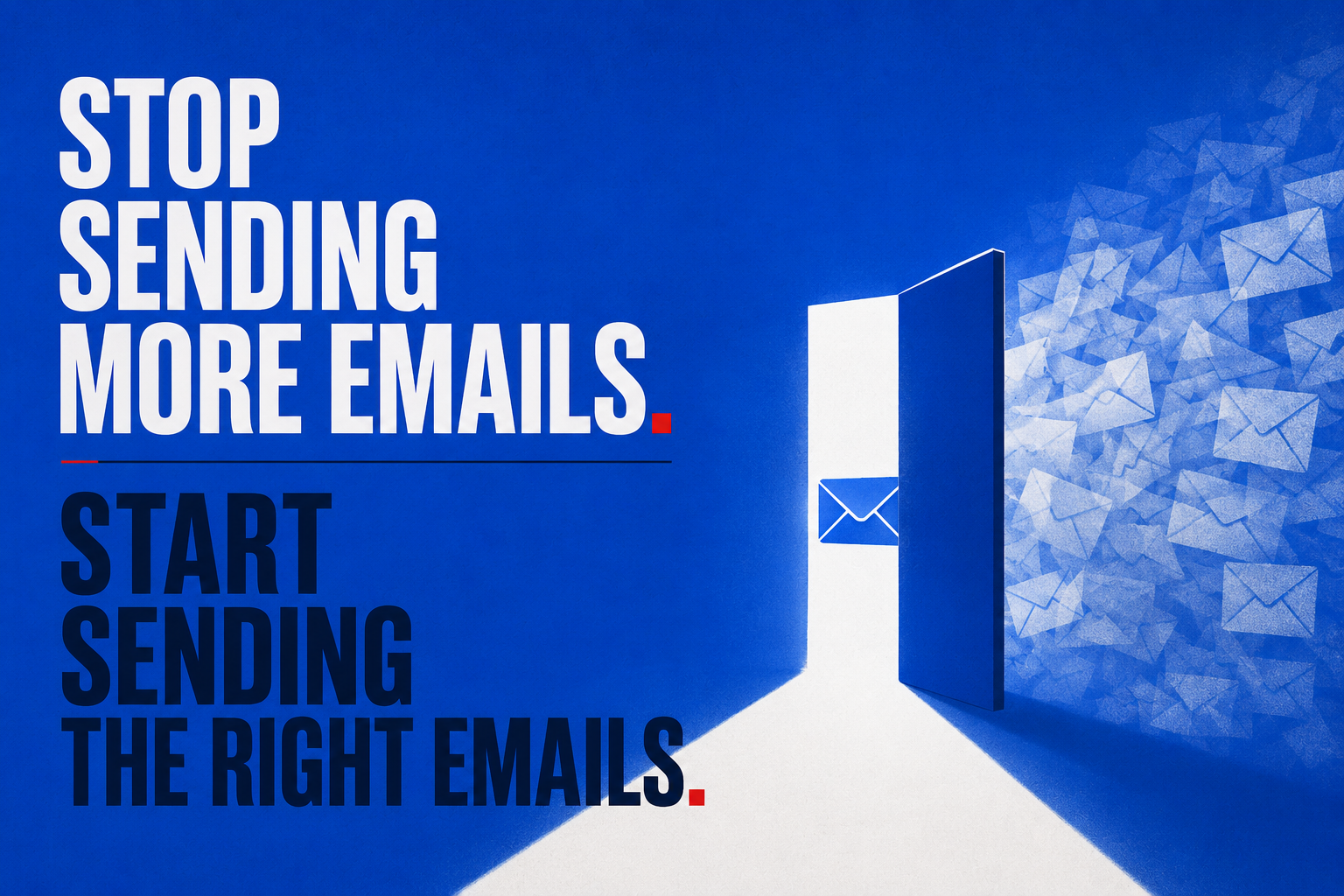
Every Tuesday morning at 9:00 AM, thousands of B2B marketers across the globe hit the same button: Send Batch Email.
They deploy polished newsletters, product announcements, or promotional blasts to tens of thousands of contacts sitting inside their CRM. The dashboard displays a brief spike in activity, followed by a familiar, disappointing reality: open rates hover around 15%, click-through rates struggle to hit 2%, and unsubscribe notifications trickle in silently.
This phenomenon is known as Email Fatigue.
In modern B2B buyer journeys, executives and decision-makers do not suffer from a lack of information; they suffer from a flood of irrelevant noise. The traditional playbook of scheduled, broad-scale email distribution—often referred to as “broadcasting”—is failing. Up to 90% of B2B marketing emails are ignored not because the copywriting is poor or the offer is weak, but because they arrive at the wrong moment.
Broadcasting focuses entirely on the marketer’s schedule: “It is Tuesday, so we must send an email.” Modern buyers operate on their own timelines. They seek solutions when an urgent operational bottleneck arises, when a budget line is approved, or when internal strategy shifts.
To capture attention and generate real pipeline, B2B organizations must evolve. They need to transition from Rigid Broadcasts to Behavioral Triggers—a real-time approach that monitors user actions, enriches CRM data, dynamically scores leads, and alerts sales representatives the precise moment a prospect is warm enough to buy.
The Paradigm Shift: Rigid Broadcasts vs. Behavioral Triggers
To understand why traditional batch emailing is losing ground, it helps to examine how buying habits have changed. B2B purchasing decisions are longer, involve multiple stakeholders, and rely heavily on self-directed research. Buyers want control over their journey.
When a company relies solely on rigid broadcasts, it forces buyers into a passive, one-size-fits-all channel. When a company adopts behavioral triggers, it creates an active, responsive dialogue.
| Dimension | Rigid Broadcasts (The Old Playbook) | Behavioral Triggers (The New Engine) |
| Execution Timing | Set by marketer’s calendar | Set by buyer’s real-time actions |
| Relevance & Context | Generic, broad-audience messaging | Hyper-relevant, highly contextual |
| Customer Experience | Disruptive, passive, push-based | Helpful, reactive, pull-based |
| CRM Synchronization | Static list segmentation | Dynamic scoring & automated alerts |
| Primary Objective | Top-of-mind brand exposure | Timely engagement & sales velocity |
The Pitfalls of Rigid Broadcasts
Rigid broadcasting operates on a “push” dynamic. The marketer crafts a message, selects a static contact list, and pushes the message out regardless of what individual recipients are doing at that moment.
-
Context Blindness: A broadcast email promoting an enterprise tier package might land in the inbox of a lead who submitted a support ticket two hours prior, creating a frustrating disconnect.
-
Inbox Desensitization: When contacts receive emails that do not match their immediate needs, they train themselves to archive or skip future communications from that sender.
-
Deliverability Erosion: Low engagement rates, low click-throughs, and high spam reports signal to email service providers (ESPs) that your domain authority is weak, pushing even your important transactional messages into the junk folder.
The Power of Behavioral Triggers
Behavioral triggering operates on a “pull and respond” dynamic. Instead of shouting at a crowd, the system listens quietly in the background. When a user performs a meaningful action—such as reading a specific blog post, downloading a gated whitepaper, or re-visiting a pricing page—the system responds instantly with a tailored message.
This model respects the buyer’s cognitive bandwidth. It delivers information at the exact second the buyer is thinking about the topic, driving significantly higher open rates, deeper engagement, and faster conversion cycles.
High-Value B2B Behavioral Trigger Scenarios
Implementing behavioral triggers does not mean setting up an infinite web of complex workflows on day one. It begins with identifying high-intent digital signals that signal genuine buying interest.
Here are three high-impact behavioral trigger scenarios every B2B marketing and sales organization should deploy.
| Trigger Action | Immediate Automated Response | Downstream Sales Acceleration |
| 1. Downloading a Niche Whitepaper | Deliver asset + 24-hr Case Study follow-up | Nurture lead based on specific topic |
| 2. Incomplete Demo Registration | Personal plain-text check-in email | CS outreach from dedicated account rep |
| 3. Repeat Pricing Page Visits | Send 1-on-1 consultation offer | Real-time Slack/CRM alert to Sales |
Trigger 1: The Specialized Asset Download
-
The User Action: A prospect fills out a form to download a whitepaper titled “Scaling Data Infrastructure for Enterprise Supply Chains.”
-
The Flawed Approach: Sending a generic “Thank You” email containing the PDF link, then adding the contact to a weekly master broadcast list.
-
The Trigger Approach:
-
The system instantly sends the requested resource.
-
Twenty-four hours later, the system checks if the user clicked the download link inside the first email.
-
If clicked, the system triggers a targeted follow-up email featuring a brief 3-minute video case study showing how a peer enterprise solved that exact supply chain bottleneck.
-
If not clicked, a simple reminder email is sent 48 hours later with an alternative reading format (e.g., an audio summary or key takeaway bullets).
-
Trigger 2: The Incomplete Registration or Onboarding Stoppage
-
The User Action: A high-fit prospect starts filling out a free trial form or demo request page, fills in their company domain, but abandons the page before clicking “Submit.”
-
The Flawed Approach: Doing nothing, or retargeting them with generic display ads across social media three weeks later.
-
The Trigger Approach:
-
Using reverse-IP lookup or partial form-capture technology, the system identifies the company and contact detail.
-
An hour later, an automated, plain-text email is triggered. The email appears to come directly from a real Customer Success Representative (not a stylized marketing template or a “No-Reply” address).
-
“Hi Sarah, I noticed you were exploring our trial setup earlier today but didn’t quite finish. Did you run into an issue with domain verification? Let me know if I can clear that up for you!”
Trigger 3: The High-Intent Pricing Page Return
-
The User Action: A prospect who engaged with your content three months ago—but went cold—suddenly visits your pricing page twice in a single afternoon and views your enterprise SLA documentation.
-
The Flawed Approach: Leaving the lead cold in the database until the next monthly newsletter goes out.
-
The Trigger Approach:
-
The website tracking pixel records the high-intent behavioral cluster.
-
The marketing automation platform sends a targeted email offering a custom ROI calculation or a 15-minute consultation with a Solutions Architect.
-
Simultaneously, the CRM triggers an urgent notification to the assigned account executive.
-
Bridging Marketing and Sales: CRM Integration & Lead Scoring
Capturing digital footprints with automated emails is only half the battle. The true commercial power of behavioral triggers emerges when marketing automation seamlessly connects with your CRM and Lead Scoring Engine.
Without lead scoring, sales teams face a constant dilemma: Which leads should I call first? They waste hours dialing cold contacts while high-intent prospects slip through the cracks due to delayed follow-ups.
| Explicit / Demographic Signals (Static) | Implicit / Behavioral Signals (Dynamic) |
| Job Title: VP of Engineering (+15) | Downloaded Technical Whitepaper (+10) |
| Company Size: 500-2,000 (+10) | Visited Pricing Page 2x (+20) |
| Industry: Enterprise SaaS (+10) | Clicked Link in Nurture Email (+5) |
| Target Geography: North America (+5) | Watched 80% of Product Webinar (+15) |
| Base Fit Score: 40 Points | Activity Score: 50 Points |
Total Combined Lead Score: 90 Points $\rightarrow$ THRESHOLD PASSED (MQL Triggered)
The Dual-Matrix Scoring Model
A mature B2B lead scoring matrix combines two distinct sets of data points: Explicit Signals (who the prospect is) and Implicit Signals (what the prospect does).
-
Explicit Data (Demographic/Firmographic Fit):
-
Target Job Title (VP, Director, C-Level): +15 Points
-
Company Revenue / Employee Count within Ideal Customer Profile (ICP): +10 Points
-
Geographic Region / Industry Alignment: +5 Points
-
-
Implicit Data (Behavioral Triggers):
-
Opens an educational broadcast email: +2 Points
-
Downloads a solution overview PDF: +10 Points
-
Attends a live product webinar: +15 Points
-
Visits the Pricing or Feature Comparison page: +20 Points
-
Setting the “Hot Lead” Threshold
When a prospect’s combined score crosses a pre-determined limit—for example, 75 Total Points—the system shifts the lead’s status from a passive subscriber to a Marketing Qualified Lead (MQL).
Passing this numerical threshold serves as the catalyst for the ultimate behavioral trigger: The Sales Hand-off Workflow.
Speed-to-Lead: The 15-Minute Rule
Research in B2B sales acceleration consistently shows that reaching out to a warm lead within 5 to 15 minutes of an active digital engagement increases conversion rates exponentially compared to calling 24 hours later.
When a behavioral threshold is met:
-
Internal CRM Alert: An immediate notification fires inside the sales team’s workspace (via Slack, Microsoft Teams, or native CRM push notifications).
-
Contextual Briefing: The alert displays the exact action that triggered the threshold: “Lead Sarah Jenkins (VP of Tech, ACME Corp) reached 85 points. She just viewed the Pricing page and downloaded the Security SLA sheet.”
-
Automated Sales Task: The CRM automatically creates a high-priority task assigned to the appropriate account manager: “Call Sarah Jenkins within 15 minutes while context is fresh.”
3-Step Implementation Roadmap: From Broadcaster to Responder
Transitioning an organization from legacy email broadcasts to an intelligent, trigger-based system does not require replacing your entire technology stack overnight. You can roll out this modern framework in three practical stages.
-
STAGE 1: Audit & Foundation (Weeks 1 – 4)
-
Audit existing email assets & unsubscribe rates.
-
Place tracking pixels across key website pages (Pricing, Features, Docs).
-
Clean CRM database & establish core ICP criteria.
-
-
STAGE 2: High-Intent Trigger Mapping (Weeks 5 – 8)
-
Identify top 3 high-intent actions (e.g., Pricing view, Form abandon).
-
Build simple 2-to-3 step responsive email workflows for each trigger.
-
Establish explicit and implicit point values for Lead Scoring.
-
-
STAGE 3: Native Integration & Sales Hand-Off (Weeks 9 – 12)
-
Set up MQL scoring thresholds in the CRM.
-
Connect real-time alerts to Sales workspace (Slack, CRM push, Email).
-
Train Sales reps on contextual outreach techniques.
-
Conclusion: Stop Broadcasting, Start Listening
The era of relying exclusively on mass, scheduled email broadcasts to generate a sustainable B2B sales pipeline is coming to a close. Buyers have developed immunity to generic, scheduled outreach that ignores their immediate operational needs.
Winning in today’s market requires building a responsive go-to-market engine. By shifting your strategy toward Behavioral Triggers, integrating dynamic Lead Scoring, and aligning sales outreach with real-time buyer actions, you replace intrusive noise with meaningful value.
Stop broadcasting what you want to say. Start responding to what your buyers are doing.