
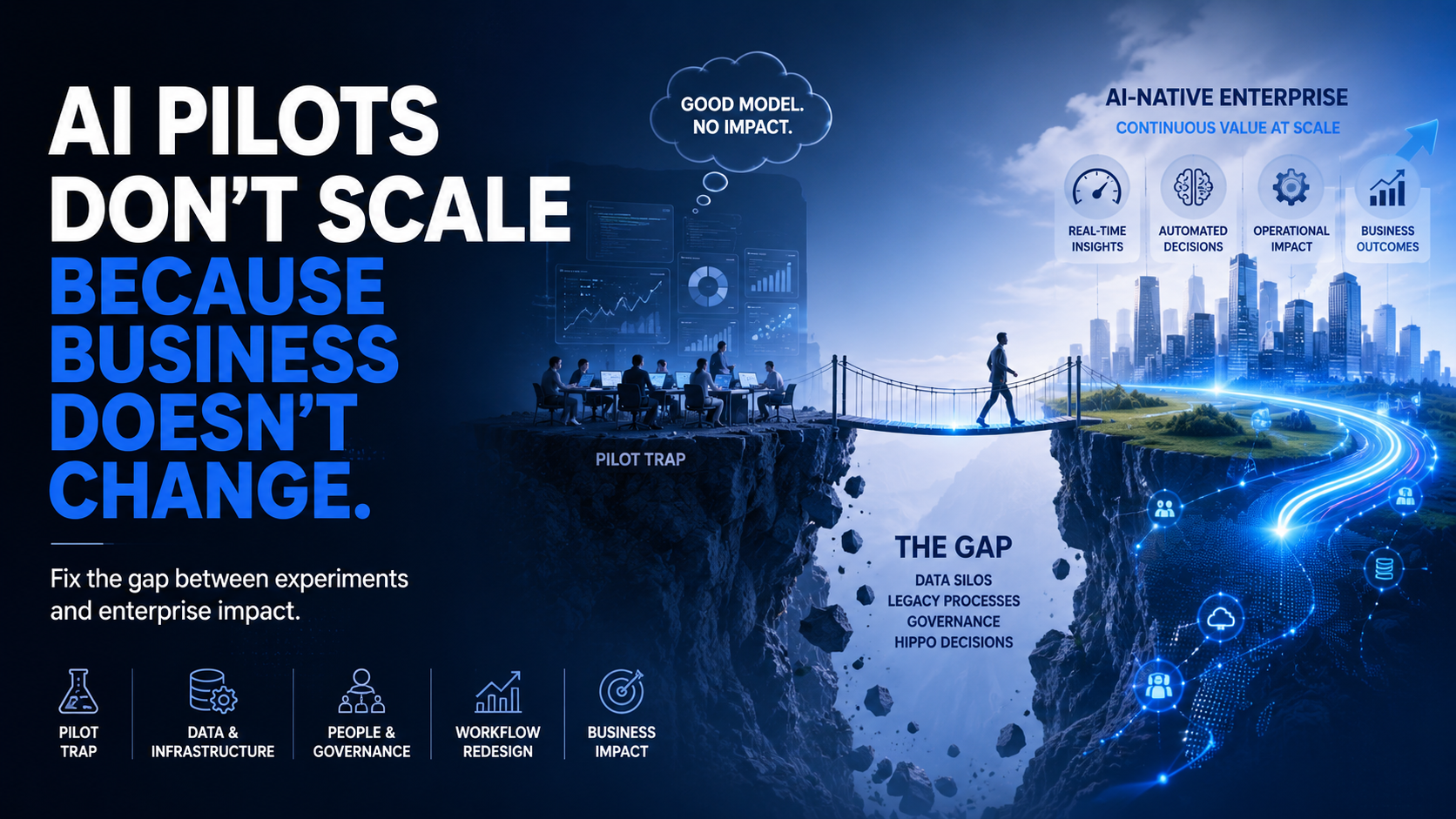
In the current corporate climate, “Artificial Intelligence” and “Big Data” have become the latest in a long line of “shiny management objects”—a term for technology hype that promises total transformation but frequently delivers only a perpetual state of expensive experimentation. As a Strategic Enterprise AI Transformation Architect, I have observed that most organizations are currently caught in the Pilot Trap. They treat AI as a laboratory curiosity, a “pet rock” for the digital age, rather than a production-grade business capability.
The skepticism regarding this trend is well-founded. When the term first gained traction, Tom Davenport—a seminal voice in business analytics—initially suspected that “Big Data” was simply “old analytics wine poured into a new bottle” (Davenport, 2014). However, the reality is more stark. The world generated approximately 2.8 zettabytes of data in 2012 alone, yet less than 0.5% of that data was ever analyzed (Davenport, 2014). This is not just a technology gap; it is a management catastrophe.
The “Hacker” mindset—characterized by quick, iterative, and often disconnected scripts—is excellent for discovery. It is, however, fundamentally incompatible with the “Production” mindset required to move the needle on a corporate P&L. Discovery is about finding what’s in the data; production is about ensuring that insight works reliably, securely, and at scale every single day. Most enterprises are proficient at the former and paralyzed by the latter. They are effectively stuck in a cycle of “Hula-Hoop” experimentation, chasing novelty while their legacy processes remain untouched and unoptimized.
The Pilot Paradox
The Pilot Paradox occurs when an AI initiative is a technical success in the lab—boasting high accuracy and successful model fit—but remains a commercial failure in the enterprise. This happens because the initiative was designed to prove the math worked, rather than proving the business could work differently. Approximately 90% of these initiatives fail to reach the bottom line because they lack the “Industrialized Flow” necessary for scale. Technical success is a vanity metric; if the model exists only on a data scientist’s laptop and never alters a core business process, its ROI is precisely zero.
1. Why “AI Works” Is Not Enough: The Gap Between Math and Money
Executives frequently fall into the trap of believing that a functional algorithm is the finish line. In reality, a functional algorithm is only one variable in a complex value equation. Davenport’s “Menu of Big Data Possibilities” illustrates that AI is not a monolith; it is a strategic menu of choices across styles of data, sources, and functional impacts (Davenport, 2014). To move beyond the pilot stage, leadership must distinguish between two different objectives:
- Internal Decision Support: Traditional analytics that help a human make a better choice. For example, United Healthcare uses voice file analysis to identify dissatisfied customers, allowing for targeted human intervention (Davenport, 2014).
- AI-Native Products/Services: Data-based offerings that create entirely new value. This is exemplified by LinkedIn’s “People You May Know” feature, which shifted the company’s growth trajectory by increasing click-through rates by 30% (Davenport, 2014).
The criteria for success in these two worlds are diametrically opposed. A “Lab Success” is mathematically sound, but an “Enterprise Scale” success must be economically and operationally sound. Consider the case of Macy’s. The retailer utilized high-performance analytics to reduce the time required to optimize pricing for 73 million items from over 27 hours to just over one hour (Davenport, 2014). This wasn’t just a technical achievement in speed; it was a business transformation that allowed Macy’s to re-price items much more frequently to adapt to changing market conditions. If the “lab” version of this model had taken 27 hours, it would have been a failure in production, regardless of its mathematical accuracy.
Lab Success vs. Enterprise Scale Criteria
| Lab Success Criteria | Enterprise Scale Criteria |
| Model Accuracy: Does the math work in a controlled environment? | ROI: Does the value generated exceed the high cost of data scientists? |
| Technical Latency: How fast does the query run on the test server? | Maintainability: Can IT support this without the original “hacker” who wrote the code? |
| Model Fit: Does it explain the sample data provided for the pilot? | TCO: What is the total cost of ownership, including Hadoop clusters and talent? |
| Data Volume: Is the data set “big” enough to be impressive? | Customer Adoption: Do users actually change their behavior based on the machine’s output? |
(Davenport, 2014).
To bridge this gap, executives must utilize the Menu of Big Data Possibilities to audit their current roadmap. Are you focusing on large-volume, unstructured data (like video/voice) or continuous flow (sensor data)? Is the industry target financial services or manufacturing? If you cannot define the “Style, Source, and Function” of your AI initiative using this matrix, you are not building a strategy; you are merely gambling on technology (Davenport, 2014).
2. The Hidden Organizational Problem: Governance, Ownership, and the “Hippo”
The failure to scale AI is rarely a failure of technology; it is a failure of the human side of data. To succeed, an organization needs more than just coders; it needs “Supermen/women” who function as a hybrid of five key traits: Hacker, Scientist, Quantitative Analyst, Trusted Adviser, and Business Expert (Davenport, 2014).
The friction occurs when these multi-talented individuals—who value discovery and agility—clash with traditional IT governance. IT organizations are designed for stability and security; they often view the data scientist’s “sandbox” as a threat to the integrity of the Enterprise Data Warehouse (EDW). This cultural conflict is a primary reason why 70–80% of business intelligence and big data projects fail (Davenport, 2014). They fail due to communication gaps, not math gaps.
The “Industrial Internet” concept, pioneered by GE with its “things that spin,” illustrates that organizational silos prevent a unified data view. If jet engine maintenance data is siloed away from sales or logistics data, the opportunity for a “Power-by-the-Hour” service model—one that guarantees uptime rather than just selling parts—evaporates.
Furthermore, we face the CDO (Chief Data Officer) Dilemma. In many large banks and legacy firms, the CDO is treated as a “house cleaner”—tasked with hygiene, governance, and policy—rather than an “architect” tasked with revenue generation (Davenport, 2014). If your CDO spends 90% of their time on data cleaning and 0% on analytical application, your AI strategy is dead on arrival.
Finally, the most dangerous animal in the boardroom remains the Hippo (Highest Paid Person’s Opinion). Even the most robust big data model at a firm like GE or UPS can be neutralized if senior leadership reverts to “gut feel” over data-driven evidence. The cost of ignoring the data is staggering; for GE, even a 1% improvement in turbine efficiency through big data could yield $66 billion in fuel savings over 15 years (Davenport, 2014). To let a “Hippo” override that potential is strategic malpractice.
3. Why Existing Workflows Kill AI at Scale: The Case for Fundamental Redesign
The core thesis of successful transformation is brutal: You cannot “bolt on” AI to a 20th-century process.
As Davenport notes, the greatest value of an insight is only realized when it is moved into production systems. However, the hand-off from “Discovery” (the lab) to “Production” (the business) is where AI goes to die. “Automating tasks” is an incremental improvement; “Redesigning workflows” is transformative. The “Human + Machine” paradigm suggests that the machine doesn’t just do the task faster; it changes the nature of the task itself.
Consider the history of UPS. Since 1954, they have been leaders in analytics, but their modern success stems from the fundamental redesign of their logistics workflow through telematics (Davenport, 2014). By instrumenting their “package cars” (the iconic brown trucks), they moved beyond reports that a manager reads to an AI-native workflow where the machine optimizes routes in real-time.
Case Study: Workflow Redesign in Operations
- Traditional Workflow + AI: A logistics company uses AI to predict truck breakdowns. The AI sends a report to a manager, who then decides whether to call the driver. The process still relies on human intervention, leading to delays and “Hippo” interference.
- AI-Native Workflow (The UPS/GE Model): As seen with GE’s gas turbines or UPS’s package cars, the data is “instrumented.” The machine communicates its own condition to an automated dispatch system. Maintenance is scheduled, and routes are adjusted without a manager ever seeing a report. The “Human-in-the-loop” only manages the exceptions, such as a nurse at WellPoint reviewing a Watson recommendation that contradicts a provider’s request (Davenport, 2014).
Transformation requires rejecting the “Discovery” mindset as the final stage. If your workflow doesn’t allow for an automated hand-off to production, you aren’t scaling; you’re just writing white papers.
4. From AI Pilot to Enterprise Capability: The Infrastructure of Scale
To move beyond pilots, you must invest in the “Big Data Stack.” This is not a single server; it is a multi-layered architecture designed for high-performance processing. This stack represents a blueprint for scale:
- Storage: Commodity hardware and Hadoop clusters that provide low-cost storage for unstructured data (video, text, sensors).
- Platform Infrastructure: Execution engines like MapReduce or Spark that split complex math across thousands of nodes.
- Application Code: Scripting languages like Python, Pig, and Hive that transform raw data into “Business Views.”
Crucially, enterprises must adopt a Coexistence Strategy. Big data technologies like Hadoop are not replacements for the Enterprise Data Warehouse (EDW); they are supplements. The EDW remains the home for “ground-truth” business data, while the big data environment serves as the “Refinery” (Davenport, 2014). Raw, unstructured data (video, logs, sensor data) enters the refinery, where it is structured and then sent to the EDW “home” for production use.
The Five Pillars of AI Scalability
- Data Hygiene: Moving from “dirty” raw data to governed, reusable assets.
- Model Versioning: Managing the life cycle of an algorithm. As seen at LinkedIn or Zynga, a model that worked yesterday may fail today as user behavior shifts.
- Security: Ensuring sensitive data, such as the claims data used by United Healthcare or the financial records at Citigroup, is protected within the Hadoop environment (Davenport, 2014).
- Latency Management: Moving from batch processing to “streaming” intelligence.
- Human-in-the-loop Overrides: Creating clear protocols for machine intervention. At WellPoint, IBM Watson suggests treatments, but a human nurse must review and approve them before they are finalized. This is the “Trusted Adviser” role in action (Davenport, 2014).
5. What AI-Native Operations Actually Look Like: The “Continuous Flow” Model
The hallmark of an AI-native company is the transition from “Batch Processing” (looking at a static pool) to “Streaming Intelligence” (analyzing a fast-flowing stream). Traditional analytics is reactive; AI-native operations are predictive and real-time.
Consider “things that spin”—the GE turbines and locomotives. A single gas turbine can produce 588 gigabytes of data per day (Davenport, 2014). In an AI-native model, this data isn’t collected and analyzed at the end of the month. It is a continuous flow. This allows for “Gas/Power System Harmonization,” optimizing the entire grid in real-time. This shift from “Hypothesis-based Analysis” (where a human asks a question) to “Machine Learning/Automated Modeling” (where the machine finds the patterns) is the difference between a legacy firm and an analytical competitor.
This model is being applied to the “Digital Cow” at J.R. Simplot, where sensors in a cow’s stomach detect illness before the animal shows symptoms (Davenport, 2014). It is being applied in “Auto-analytics” at Nike+ and Fitbit to track human performance. In every case, the data is not a report; it is a continuous stream that triggers an immediate action.
6. A Practical Framework for Scaling AI: The DELTTA Model
To audit your current standing and move toward enterprise capability, executives must utilize the DELTTA Model, synthesized specifically for the era of big data (Davenport, 2014).
D (Data)
- Command: Move from “Data as an exhaust” to “Data as a corporate asset.”
- Audit: Are you integrating external data? In a Stanford experiment, movie genre data from IMDB proved more valuable than the algorithm itself in predicting Netflix preferences (Davenport, 2014).
- Action: Don’t just analyze what you have; seek out the 25% of external data that holds potential value.
E (Enterprise)
- Command: Break down silos for a horizontal “Big Data Stack.”
- Audit: Does your big data group “talk to” your IT organization, or are they running a “shadow IT” operation?
- Action: Centralize your discovery platform (the “Refinery”) but distribute the insights across business units.
L (Leadership)
- Command: Adopt a “Founder’s Mentality” toward data-driven experimentation.
- Audit: Is your leadership (like Reid Hoffman at LinkedIn) willing to bypass hierarchy to support a data-driven prototype? (Davenport, 2014).
- Action: Appoint a Chief Analytics Officer with a direct line to the CEO, not just a CDO tasked with house cleaning.
T (Targets)
- Command: Select “Strategic Hubs” over “Convenient Pilots.”
- Audit: Are you picking projects because they are easy, or because they transform the P&L?
- Action: Focus on areas like supply chain risk or customer “next best offer” where the volume of data is high and the decision frequency is high.
T (Technology)
- Command: Align Cloud, Hadoop, and In-memory analytics with business velocity.
- Audit: Can your infrastructure handle 2.5 quintillion bytes of data per day? (Davenport, 2014).
- Action: Audit your “Time to Insight.” If it takes 27 hours to run a model (Macy’s), you are already too slow.
A (Analysts)
- Command: Assemble the “Horizontal Data Scientist” team.
- Audit: Do you have “Supermen/women” who understand both eigenvalues and P&L?
- Action: Stop looking for one perfect hire. Build teams that combine hackers, statisticians, and business experts. Use the “Insight Data Science Fellows Program” model to bridge the gap between academic science and business impact (Davenport, 2014).
The High Cost of Staying Small
There is an existential risk in remaining in the “Pilot Trap.” Companies like Google, Amazon, and LinkedIn are “Analytical Competitors from Birth” (Davenport, 2014). They do not “do” AI; they are AI. They use big data to design content (Netflix’s House of Cards) and predict customer connections before the customer even knows they exist.
For established firms like Macy’s, UPS, and GE, the challenge is to integrate these new capabilities into a legacy environment before they are disrupted. The cost of staying small—of treating AI as a pet rock or a Hula-Hoop—is to eventually be replaced by a competitor who has already moved their AI into production.
The goal of AI is not to prove the technology works—it is to prove the business can work differently.