
Beyond “New Wine in Old Bottles”: A Strategic Leader’s Guide to Business Re-Engineering via Agentic AI
Many business leaders enter the AI race with a fundamentally flawed question: “Where can I squeeze AI into my current workflows?”
That is 20th-century thinking. True AI transformation is not a software upgrade project or a simple chatbot installation. It is a comprehensive re-engineering of your business model and operational economics. To achieve a breakthrough, you must stop “retrofitting” AI into outdated structures and begin designing a system built entirely around the native capabilities of AI from day one.
1. The Economic Reality of the AI Era: Cheap Prediction
Through a pragmatic economic lens, the current wave of AI is not creating a sci-fi “general intelligence.” Instead, it is driving a historic, unprecedented drop in the cost of “Prediction”.
Prediction is the process of using the data you have to generate information and behaviors you do not have.
When the cost of prediction plummets to near zero, it fundamentally alters how businesses make decisions and solve core operational challenges.
We are currently living in a transitional lag—“The Between Times”. Technology has leaped ahead, but corporate structures remain anchored in the past.
-
A Lesson from History: Twenty years after the incandescent light bulb was invented, only 3% of households had electricity. Why? Because people were trying to plug modern light bulbs into the sockets of old steam-powered systems, rather than redesigning the power grid and architectural layouts to optimize this new energy source.
If you continue to deploy AI in a fragmented manner, you are wasting valuable resources trying to light up a steam engine.
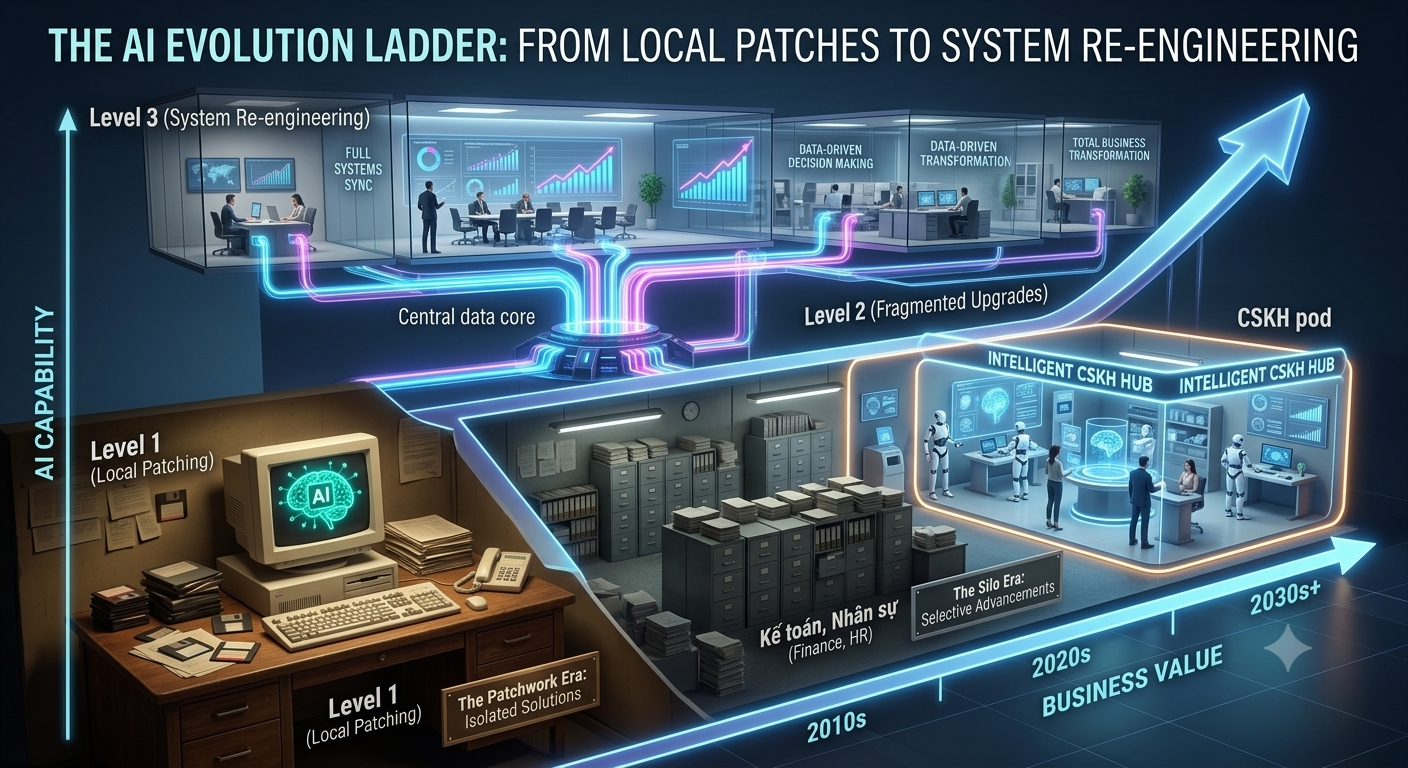
2. The Executive’s Choice: Three Steps of AI Evolution
To thrive in “The Between Times”, leaders must distinguish between three levels of AI adoption to properly position their organization in the market:
-
Level 1 — Local Patching (Point Solutions): This involves “digitizing” individual manual tasks with AI (such as using ChatGPT to write emails faster) while keeping the legacy operational framework intact. This only yields temporary, minor cost savings rather than scaling your capacity or unlocking a true competitive advantage.
-
Level 2 — Fragmented Upgrades (Application Solutions): Redesigning a specific department or workflow around AI capabilities (e.g., optimizing customer service with a smart chatbot). While performance in that specific area will skyrocket, the broader business remains held back by the bottlenecks of the legacy system.
-
Level 3 — System Re-engineering (System Solutions): Tearing down and rebuilding the entire business model around AI’s predictive capabilities. This is a massive leap that turns data into an autonomous engine, creating a robust competitive moat and market dominance.

The Quantum Leap to Agentic AI
In retail, a Level 1 solution merely helps predict inventory demand (the old flow: Customer shops first $rightarrow$ Merchant ships second).
In contrast, a Level 3 system solution achieves such high predictive accuracy that the merchant can package and ship the item before the customer even clicks the buy button (the new flow: Merchant ships first $rightarrow$ Customer shops second).
This is the gateway to Agentic AI—autonomous systems that do not just recommend actions but independently execute complex, multi-stage workflows on your behalf. It mirrors how Spotify’s algorithm automatically generates your personalized “Discover Weekly” playlist, sparing you from ever having to curate music manually again.
3. The Three Pillars of a Successful AI Strategy
Any sustainable AI transformation must stand on a sturdy three-legged stool built on modern enterprise frameworks:
-
Pillar 1 — Actionable Processes (Process): Every AI initiative must align with a concrete financial North Star, such as driving EBIT growth. Data Governance should never be treated as administrative red tape. Instead, true governance acts as a high-quality filter, ensuring your data remains pristine, secure, and ready for AI to extract immediate economic value.
-
Pillar 2 — Human Mindset (People): Create a culture of digital democratization. Eradicate the fear of AI replacement by upskilling employees to see AI as an “execution partner” that multiplies their individual capabilities. Change management dictates 80% of the success or failure of your AI journey.
-
Pillar 3 — Technology Foundation (Platform): Eliminate data silos by unifying data warehouses and data lakes into a singular Lakehouse architecture. This platform must prioritize open standards to prevent “Vendor Lock-in” (becoming dependent on a single software provider) and guarantee maximum agility as technologies evolve.
4. Case Study: The Power of a Unified AI Ecosystem
To understand how a “System Solution” operates in the wild, look at NAL Japan’s Cross AI ecosystem. This is a fully integrated environment where tasks do not run in isolation, but are orchestrated by a central brain:
-
NAL Orchestrator: The command center that ingests requests and deploys specialized AI agents to execute tasks in real-time.
-
Integrated Multi-Agent Modules:
-
CrossChat & CrossMeet: Transmute everyday conversations and meetings into highly searchable digital knowledge.
-
CrossTask & CrossCode: Automate repetitive routines and supercharge software development pipelines.
-
CrossDB, CrossDB Hub, & CrossWiki: Dismantle corporate data silos and automatically systemize institutional knowledge.
-
CrossTerminal & CrossSecurity: Provide multi-layered, enterprise-grade security shields for all data operations.
-
-
Quantum Grid Network: Keeps all modules communicating with near-zero latency while maintaining absolute security barriers to prevent sensitive corporate data from leaking to the public internet.
5. The 3-Stage AI Roadmap
Transitioning your enterprise is a marathon. You can mitigate operational risks by applying this structured, three-stage roadmap:
🚀 Stage 1: Establish the Foundation | Months 3 – 6
-
Objective: Audit existing technical infrastructure and data readiness.
-
Key Action: Standardize data quality, build a robust governance framework, and run highly targeted pilot projects with measurable outcomes.

📈 Stage 2: Scale the Application | Months 6 – 12
-
Objective: Move successful pilot programs into daily, real-world operations.
-
Key Action: Redesign workflows specifically around AI capabilities. Seamlessly integrate AI tools into platforms your team already uses—such as utilizing native Gmail-native tools like Sald.io to manage CRM pipelines, Mail Merge campaigns, and AI agents right inside their inboxes without disrupting their daily habits.
🏆 Stage 3: Enterprise-Wide Transformation | Months 12 – 24+
-
Objective: AI becomes the core operating system of the organization.
-
Key Action: Deploy fully autonomous AI agents to manage cross-departmental workflows. This completely frees your workforce from mundane tasks, enabling them to focus 100% on creative problem-solving and strategic business growth.
6. Measuring Success: ROI and the 3 Death Traps to Avoid
Systemic investment in AI yields extraordinary returns. On average, organizations see an ROI of 3.7x, and for industry-leading “AI High Performers,” that return skyrockets to 10.3x.
Yet, 80% of organizations still fail by falling into three classic traps:
-
Chasing “Shiny” Tech: Implementing complex AI models because they are trendy, rather than aligning them with a specific, painful business problem.
-
Poor Data Foundations: Neglecting data cleaning and governance, which inevitably leads to a “Garbage in, garbage out” cycle.
-
Ignoring the Human Factor: Failing to invest in Change Management, which breeds quiet resistance from employees who fear for their job security.
The Executive Summary
Clean data and a solid governance system are the absolute bedrock of any AI initiative—no matter how advanced the model is. AI is not designed to replace human ingenuity, but to liberate us from monotony. The intersection of sharp executive strategy and the raw efficiency of an autonomous AI system is the ultimate golden key to dominating the modern marketplace.