
From Algorithms to Revenue: Leveraging Machine Learning & Deep Learning for B2B Growth
In the era of Big Data, Artificial Intelligence (AI) is often tossed around as a catch-all buzzword for modern marketing. However, stopping at a surface-level understanding can lead B2B leaders into the trap of investing in the wrong software or failing to utilize the data they already have.
To truly transform AI into an engine for growth, businesses must demystify the “gray area” between its two core subsets: Machine Learning (ML) and Deep Learning (DL). Understanding these technical nuances is vital for making informed budget allocations and choosing the right technology for each stage of your sales funnel.
1. The Paradigm Shift: Why Modern B2B Marketing Demands AI
B2B marketing has evolved far beyond mass, generic email blasts. Today’s corporate buyers are more autonomous than ever—they proactively research across social media, mobile devices, and digital touchpoints, comparing solutions long before making direct contact with a sales representative.
This shift toward customer-centricity is being driven by three economic forces:
-
The Pressure of Globalization: As markets expand, buyer behavior grows increasingly complex and diverse. AI is the only tool capable of processing this massive influx of multi-layered data to deliver precise messaging.
-
Escalated Competition: With lower barriers to entry in almost every industry, providing an exceptional customer experience by anticipating client needs is the only sustainable differentiator.
-
Real-Time Responsiveness: Businesses must respond instantly to prospect behaviors to capture opportunities during critical intent windows (the “Golden Hours”).
2. Machine Learning (ML): The Analytical Engine for Structured Data
Machine Learning is the core branch of AI where computers are not hard-coded with rigid “IF-THEN” rules written by humans. Instead, the system “learns” from historical data to independently identify patterns.
For a marketer, ML acts as a brilliant data analyst, exceptionally skilled at handling structured data from your CRM across three primary methodologies:
-
Supervised Learning: The model is trained on historical data where the outcome is already known (labeled data).
-
Practical Application: Lead Scoring. Predicting conversion probabilities based on the behavioral history of previous won or lost deals.
-
-
Unsupervised Learning: The model automatically uncovers hidden structures and groupings within data without human guidance.
-
Practical Application: Audience Segmentation. Dynamically grouping companies that share similar buying behaviors or Ideal Customer Profile (ICP) attributes.
-
-
Reinforcement Learning: The system learns through continuous trial and error to maximize a specific “reward.”
-
Practical Application: Ad Bid Optimization. Automatically adjusting ad spend in real-time to hit target ROI or CPA metrics.
-
The Bottom Line: ML transitions your business away from intuition-based guessing, moving instead toward highly reliable, data-informed decision-making.
3. Deep Learning (DL): When Computers Extract Features Like the Human Brain
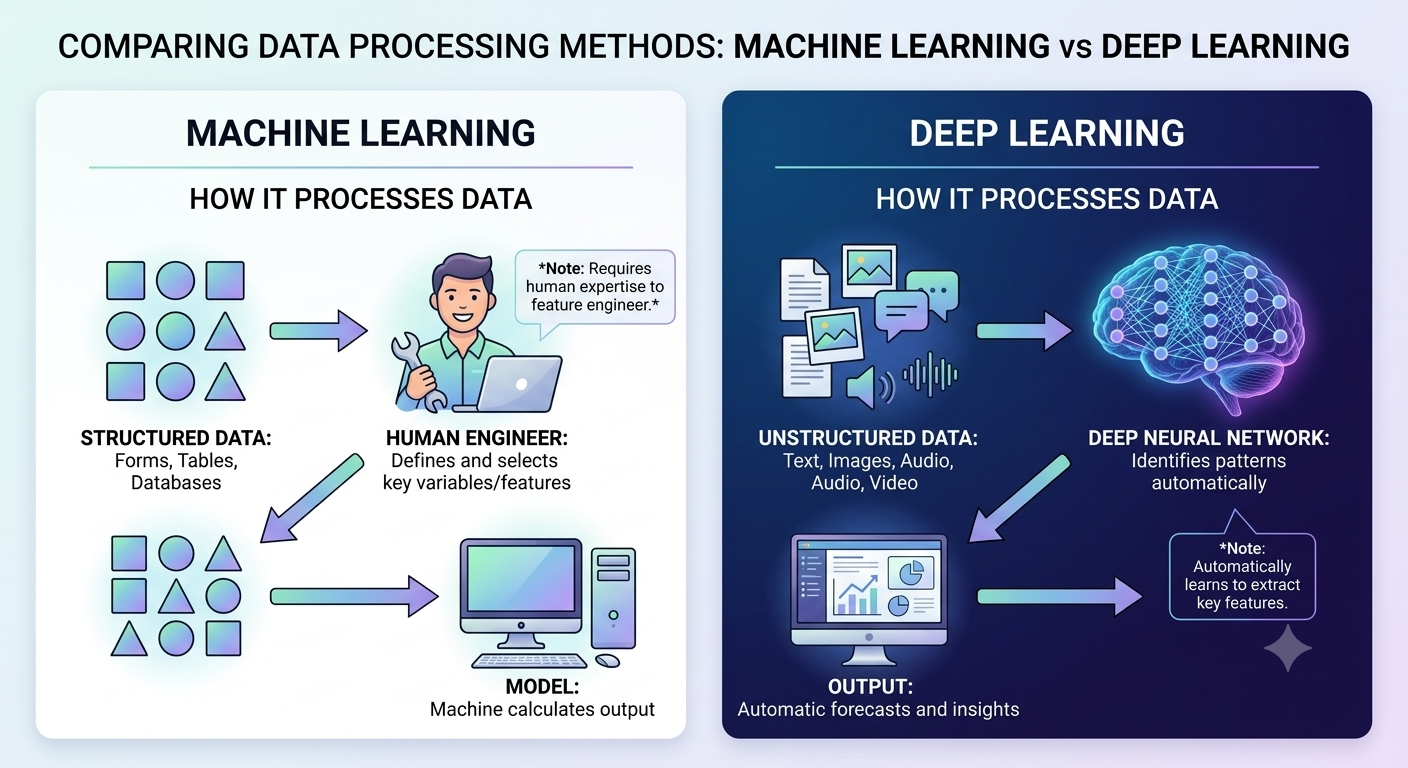
While traditional Machine Learning requires a human to feed the system specific variables (Feature Engineering)—such as instructing the computer to look at “job title” and “email opens” to score a lead—Deep Learning (DL) takes automation a step further.
Built on multi-layered artificial neural networks, Deep Learning is uniquely capable of Autonomous Feature Extraction from raw, unstructured data (such as open-ended text, customer call audio, or video).
-
How It Thinks: DL can automatically detect highly subtle purchase indicators that humans might never consider (e.g., a specific combination of a prospect browsing the pricing page at 2:00 AM while typing a unique phrase into a chatbot).
-
Self-Correction: Through an algorithm called Backpropagation, when the model makes an incorrect prediction about a lead’s conversion probability, it traces backward through the neural layers to adjust its “weights.” This minimizes the Loss Function, meaning its accuracy compounds over time.
-
Decoding Complexity: Mathematical Activation Functions introduce non-linearity, allowing the neural network to map out overlapping, multi-touchpoint B2B buyer journeys that never follow a straight line.
Advanced DL architectures form the backbone of Natural Language Processing (NLP), enabling machines to deeply understand human tone, sentiment, and communication context.
4. Strategic Comparison: Machine Learning vs. Deep Learning for Marketers
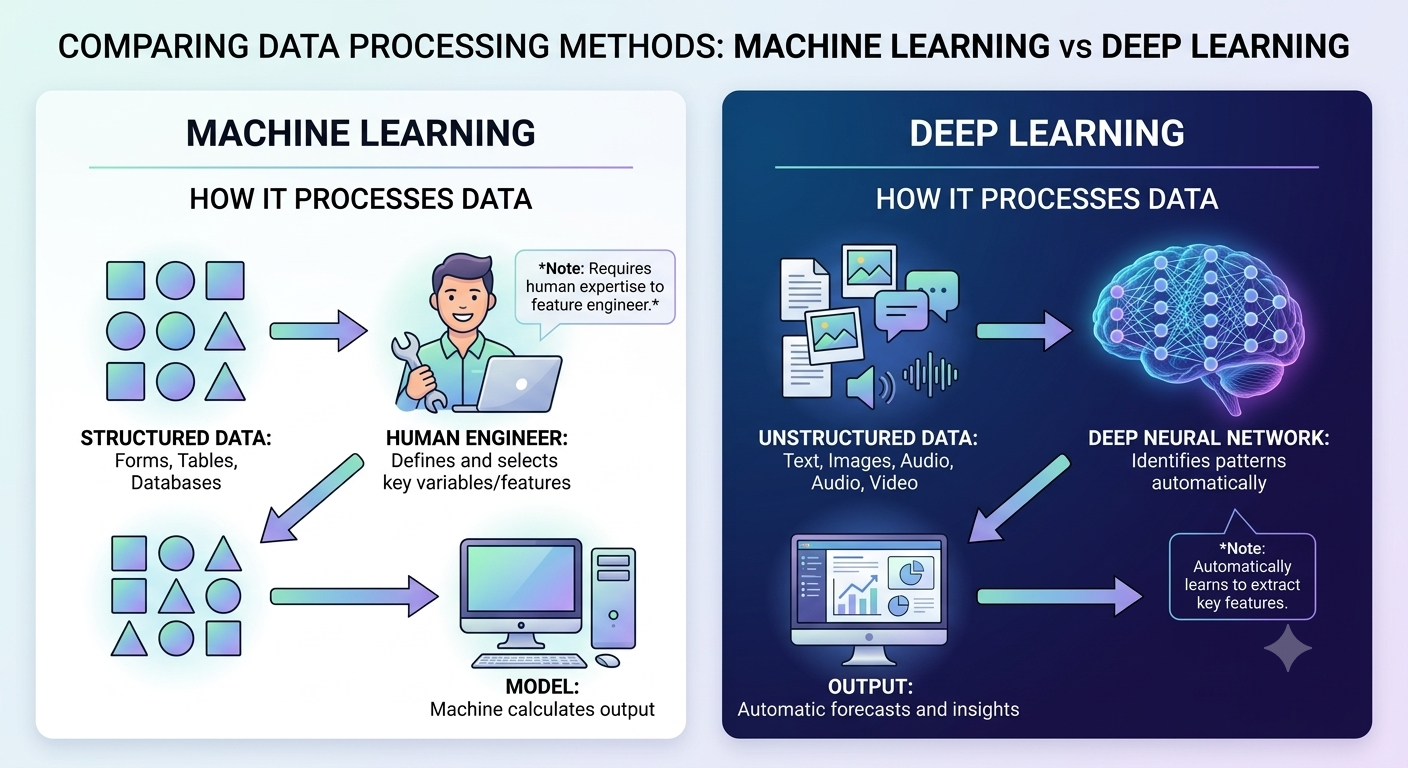
Choosing between ML and DL is not a matter of which technology is more advanced, but rather which fits your business problem and available resources:
| Criterion | Machine Learning (ML) | Deep Learning (DL) |
| Core Technique | Requires human intervention to define key variables (Feature Engineering). | Automatically learns and extracts features directly from raw data. |
| Data Requirements | Performs exceptionally well on small to medium-sized datasets. | Requires massive datasets (Big Data) to avoid bias or overfitting. |
| Complexity & Setup | Low to medium; relatively easy to implement, maintain, and audit. | Very high; relies on complex, multi-layered neural network structures. |
| Hardware Needs | Can run smoothly on standard computers (CPUs). | Requires powerful, specialized graphics processors (GPUs/TPUs). |
| Interpretability | High. You can easily explain why a lead received a certain score. | Low. Often referred to as a “Black Box” due to millions of hidden parameters. |
Strategic Advice: If you are at the beginning of your AI transformation journey, prioritize Machine Learning to clean and optimize your structured CRM data. Transition to Deep Learning only when you possess massive amounts of data and need to solve unstructured problems, such as sentiment analysis across thousands of customer support recordings or hyper-personalized video generation at scale.
5. The Tool Ecosystem: Translating AI Theory into Practical Revenue
The convergence of ML and DL has given growth marketers an incredibly powerful arsenal across every single touchpoint:
Advanced Account-Based Profiling
Instead of manual, gut-based segmentation, modern revenue teams use RFM (Recency, Frequency, Monetary) frameworks driven by Boosting Trees algorithms (like AdaBoost or Gradient Boosting). This combination handles the non-linear relationships within behavioral data, helping teams predict churn risks and pinpoint high-value ICPs at the account level.
Predictive Analytics & Resource Optimization
Platforms like Pecan AI specialize in predicting Customer Lifetime Value (LTV) and future revenue without requiring a massive, in-house team of data scientists. Simultaneously, behavior-analytics tools like Glassbox catch early signals of user friction within SaaS products, letting customer success teams intervene before a client churns.
Content Personalization & NLP
-
Brandwatch: Leverages NLP for advanced Sentiment Analysis, keeping tabs on how the market genuinely feels about your brand versus your competitors.
-
Persado: Uses Deep Learning (Motivation AI) to mathematically select the exact words in an email subject line or body copy based on behavioral psychology, maximizing open and conversion rates.
The Actionable Tech Stack for Lean Teams
To translate these technological frameworks into everyday workflows, lean B2B teams can look to specialized, ready-to-use platforms:
-
Salesforce Einstein & HubSpot: Pioneers in embedding ML for automated lead scoring and sales forecasting.
-
Clearbit: Uses ML to “enrich” corporate datasets (company size, revenue, tech stack), acting as an essential engine for Account-Based Marketing (ABM).
-
Oribi: Provides no-code funnel analytics and user journey tracking to highlight leaks in your conversion path.
-
Optimizely: Automated content catalog tagging and web personalization at scale.
-
Sald.io: The ideal growth engine for lean B2B operations. It unifies lead research, CRM pipelines, and marketing automation directly inside the native Gmail interface—eliminating tool fatigue and keeping everything in one workspace.
6. Challenges, Ethics, and the Future of AI
Deploying AI successfully requires strategic vigilance. Leaders must actively navigate three major hurdles:
-
Privacy & Compliance: Ensuring all data used to train algorithms strictly adheres to international legal standards like GDPR and CCPA.
-
Algorithmic Bias: Machines learn from historical data. If past data contains biases (e.g., underrepresenting certain business sizes or industries), the AI’s predictive outputs will be inherently flawed.
-
The Talent Gap: A profound shortage of “hybrid” professionals who can bridge the gap between creative marketing strategy and technical data science.
The Horizon of AGI (Artificial General Intelligence): Unlike today’s narrow AI, the future belongs to systems capable of common-sense reasoning. AGI will fundamentally reshape how B2B buyers find solutions. Search engines will no longer just return lists of links; they will act as corporate consultants, offering tailored solutions based on a deep, empathetic understanding of a company’s unique business context.
The CMO Roadmap
The difference between Machine Learning and Deep Learning is ultimately a benchmark of your organization’s data maturity.
AI was never meant to replace a marketer’s strategic thinking, creativity, or business empathy. Instead, it is here to liberate human professionals from repetitive, mundane tasks so they can focus on what machines cannot replicate. Start lean: master your structured data with Machine Learning first, build clean pipeline filters, and let AI empower your team to dominate the digital marketplace.